

TL;DR:
- Athletes need balanced vitamin intake to support energy, recovery, and immune health.
- Over-supplementation can impair training adaptations and cause health risks.
- Testing and a nutrient-rich diet are essential for personalized vitamin optimization.
Most athletes know that nutrition matters, but the conversation around vitamins is rarely straightforward. There’s a persistent belief in gym culture that more is better: more protein, more creatine, and yes, more vitamins. The reality is more nuanced. Both deficiency and excess carry real consequences for your training, your recovery, and your long-term health. Getting your vitamin intake right is not about swallowing handfuls of supplements; it’s about understanding what your body actually needs and when. This article breaks down the science, the practical guidance, and the common mistakes so you can make smarter choices for your sport.
Table of Contents
- Why vitamins are essential for athletes
- Key vitamins and their roles in performance and recovery
- The risks of deficiency and over-supplementation
- How to optimise your vitamin intake for your sport
- What most athletes get wrong about vitamins and sports
- Take your sports nutrition to the next level
- Frequently asked questions
Key Takeaways
| Point | Details |
|---|---|
| Balance is vital | Both deficiency and excess of vitamins can impact athletic performance and recovery. |
| Test and personalise | Testing and tailoring vitamin strategies to your sport, age, and lifestyle delivers best results. |
| Diet first approach | Consuming a nutrient-rich, varied diet is the most effective foundation for meeting your vitamin needs. |
| Supplement wisely | Supplements should only be used to address existing deficiencies or specific requirements. |
Why vitamins are essential for athletes
Vitamins are not optional extras in a training programme. They are biological catalysts, meaning they enable the chemical reactions your body depends on to produce energy, repair tissue, and defend against illness. Without adequate levels, those processes slow down or break down entirely. For athletes, that translates directly into poorer sessions, longer recovery times, and a higher risk of injury.
What makes this especially relevant for you is that training significantly increases your body’s demand for certain vitamins. Every hard session generates oxidative stress, a process where free radicals accumulate and begin damaging cells. Your body needs specific vitamins to neutralise that damage and keep systems running efficiently. As sports nutrition basics explain, understanding these fundamentals is the foundation of any effective performance nutrition strategy.
Research confirms that vitamins counter oxidative stress, supporting energy pathways, muscle repair, and injury prevention. This is not theoretical. Athletes who train at high intensities are measurably more exposed to cellular damage than sedentary individuals, which means their vitamin requirements are genuinely elevated.
Here is a quick overview of the core functions vitamins serve for athletes:
- Energy production: B vitamins convert carbohydrates, fats, and proteins into usable fuel
- Muscle repair: Vitamins A, C, and D support tissue regeneration after training stress
- Immune defence: Vitamins C and D reduce susceptibility to illness during heavy training blocks
- Bone integrity: Vitamin D and K work together to maintain skeletal strength under load
- Antioxidant protection: Vitamins C and E neutralise free radicals generated during exercise
Balanced intake, not excess, brings maximal benefit. More is not always more when it comes to vitamins and athletic performance.
The key takeaway here is balance. Deficiency impairs your performance, but flooding your system with vitamins beyond what it can use does not give you an edge. In many cases, it actively works against you.
Key vitamins and their roles in performance and recovery
Not all vitamins carry equal weight for athletes. Some are more directly tied to performance outcomes than others. Understanding what each one does allows you to focus your attention and your budget on what genuinely matters.
B-complex vitamins are arguably the most performance-critical group. B1 (thiamine), B2 (riboflavin), B3 (niacin), B6, B9 (folate), and B12 each play a role in energy metabolism. B12 and folate are particularly important for red blood cell production, which directly affects how much oxygen your muscles receive during exercise. Low B12 is a common issue for athletes following plant-based diets and can cause fatigue that is easily mistaken for overtraining.
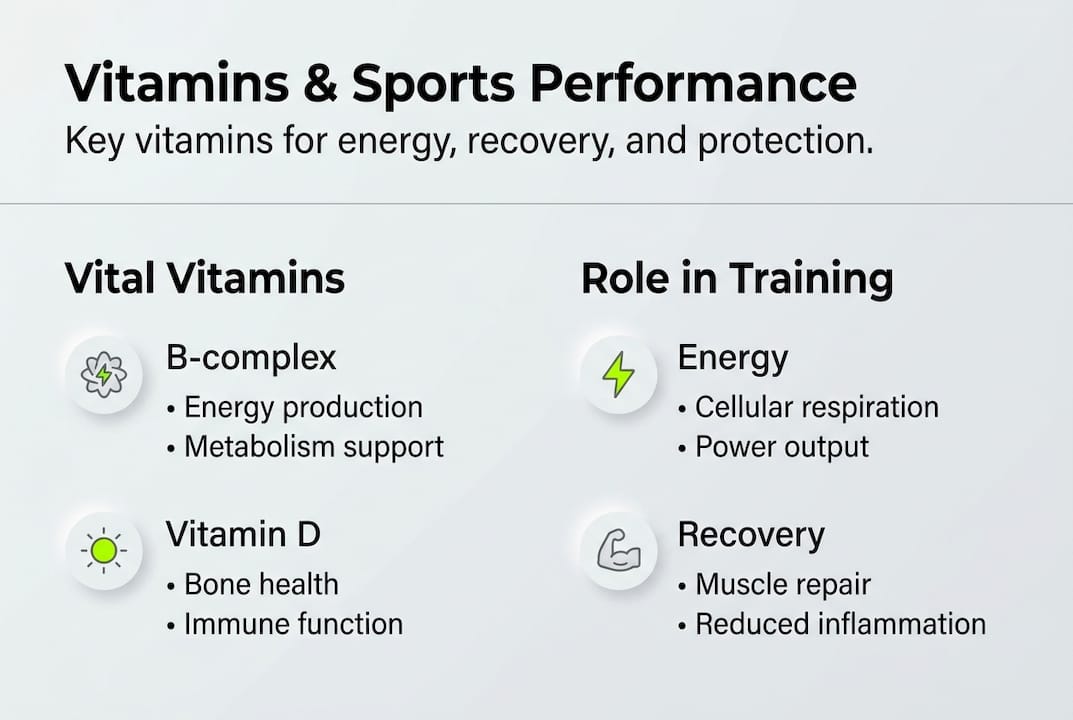
Vitamin D deserves special attention. Vitamin D deficiency is highly prevalent in athletes, particularly those who train indoors or live in northern latitudes. Deficiency is linked to reduced muscle function, slower recovery, increased injury risk, and compromised immune health. Supplementation in deficient athletes has shown clear improvements in musculoskeletal health and performance outcomes. This is one area where supplementation has strong evidence behind it.

Vitamins C and E are powerful antioxidants that help manage the oxidative stress generated by intense training. Antioxidant vitamins C and E attenuate exercise-induced muscle damage and support faster recovery. However, there is a catch, which we will address in the next section. For now, understand that moderate intake is protective and beneficial.
Vitamin A is often overlooked in sports nutrition discussions. It supports immune function, cell energy production, and the integrity of mucous membranes, your first line of defence against respiratory infections that can derail a training block.
Here is a summary of the major vitamins and their primary relevance to athletes:
| Vitamin | Primary role for athletes | Key sources |
|---|---|---|
| B-complex | Energy metabolism, red blood cell production | Meat, eggs, legumes, wholegrains |
| Vitamin D | Muscle function, bone health, immunity | Sunlight, oily fish, fortified foods |
| Vitamin C | Antioxidant protection, collagen synthesis | Citrus, berries, peppers |
| Vitamin E | Cell membrane protection, recovery | Nuts, seeds, vegetable oils |
| Vitamin A | Immunity, cell energy, tissue repair | Liver, dairy, orange vegetables |
For deeper reading on supporting your recovery with targeted nutrition, the guide on muscle recovery strategies is worth your time. You can also explore top antioxidant supplements to understand which products are worth considering.
Pro Tip: If you train predominantly indoors or live in the UK, get your vitamin D levels tested before winter. Deficiency is far more common than most athletes realise, and it can quietly undermine months of hard training.
The risks of deficiency and over-supplementation
To make effective choices, it is essential to understand the potential downsides of both too little and too much vitamin intake. This is where many athletes go wrong in both directions.
Deficiency is the more obvious problem. When your body lacks adequate vitamins, performance suffers in measurable ways. Here are the most common signs that deficiency may be affecting your training:
- Persistent fatigue that does not resolve with rest
- Slower recovery between sessions
- Increased frequency of illness or infection
- Unexplained decline in strength or endurance
- Poor mood, concentration, or motivation during training
Research shows that deficiencies impair endurance and recovery, but here is what is less commonly discussed: excess provides no extra performance benefit, and in some cases causes real harm.
Take antioxidants as a prime example. Vitamins C and E, when taken in high doses, can actually blunt the training adaptations your body is trying to make. Exercise creates a controlled amount of oxidative stress, and that stress is part of the signal that tells your body to get stronger and more efficient. Flood the system with antioxidants and you dampen that signal. High-dose antioxidants above 400mg per day can impair performance by blunting adaptive responses, with lower doses proving sufficient without causing harm.
This is a genuinely counter-intuitive finding. The supplement that is supposed to help your recovery may actually be slowing your long-term progress if you take too much of it.
Here is a comparison of the effects of deficiency versus excess for key vitamins:
| Vitamin | Effect of deficiency | Effect of excess |
|---|---|---|
| Vitamin D | Muscle weakness, injury risk, fatigue | Toxicity, hypercalcaemia (rare but serious) |
| Vitamin C | Slower recovery, immune suppression | Blunted training adaptation |
| Vitamin E | Increased oxidative damage | Impaired mitochondrial signalling |
| B12 | Fatigue, anaemia, nerve issues | Generally well tolerated |
Supplementation is most effective for athletes with confirmed deficiencies. For those already meeting their needs through diet, adding more rarely delivers a performance boost and may work against progress. The resource on selecting athlete vitamins offers practical guidance on navigating these choices, and the guide on antioxidants for fitness helps clarify which antioxidant products are genuinely useful.
How to optimise your vitamin intake for your sport
With an understanding of balance, here is how you can apply these insights to personalise your vitamin regimen for maximum benefit.
The starting point is always food. A varied, nutrient-rich diet covering a wide range of whole foods will meet the majority of your vitamin needs without supplementation. Prioritise colourful vegetables and fruit, quality protein sources, wholegrains, oily fish, and dairy or fortified alternatives. Variety is the operative word here. Eating the same five meals on rotation makes it very easy to develop gaps in your intake without realising it.
When it comes to supplementation, research is clear that supplementation should target confirmed deficiencies and be individualised by sport, age, sex, and training load. Diet should always come first. Supplements are not a shortcut around a poor diet; they are a targeted tool for addressing specific shortfalls.
Here is a practical framework for optimising your vitamin intake:
- Get tested: Ask your GP or sports nutritionist for a blood panel covering vitamin D, B12, folate, and iron before adding supplements
- Prioritise food first: Build your meals around nutrient-dense whole foods before reaching for a pill
- Match your sport: Endurance athletes have different needs to strength athletes; indoor sport increases vitamin D risk
- Adjust for season: UK winters dramatically reduce sunlight exposure, making vitamin D supplementation more relevant from October to March
- Review regularly: Needs change with training load, age, and life circumstances; reassess every six to twelve months
For sport-specific guidance, the sports-specific supplementation guide is an excellent resource. If you are unsure about dosages, the supplement dosage guide provides clear, evidence-based reference points for UK athletes.
Pro Tip: Do not wait until you feel run down to think about vitamins. By the time symptoms appear, deficiency has often been developing for weeks or months. Proactive testing at the start of each training season puts you ahead of the problem.
What most athletes get wrong about vitamins and sports
Building on these practical steps, it is vital to challenge some of the biggest misconceptions in the world of sports nutrition.
The most common mistake is treating vitamins like performance enhancers in the same category as creatine or caffeine. They are not. Vitamins are maintenance tools. When you are deficient, correcting that deficiency can feel transformative because you are simply restoring normal function. But if your levels are already adequate, taking more does very little. Elite athletes with adequate status see minimal performance gains from routine vitamin supplements, with the clearest benefit reserved for vitamin D in deficient indoor athletes.
The real competitive edge comes from knowing your own body. That means testing, not guessing. It means building a diet that genuinely covers your nutritional bases, not relying on a multivitamin to compensate for a poor eating pattern. And it means adjusting your approach as your training, your season, and your life change.
For practical examples of how to structure your supplement use intelligently, the guide on supplement examples for athletes is a useful reference. The athletes who get the most from their nutrition are not the ones taking the most supplements. They are the ones who understand why they are taking each one.
Take your sports nutrition to the next level
Ready to put this knowledge into action? At MyGymSupplements, we have carefully curated a selection of vitamins and health supplements aligned with the latest sports nutrition research. Whether you are addressing a confirmed deficiency or looking to support your training with evidence-based products, our range is built with athletes in mind. Browse our guides and product categories to find what fits your goals, your sport, and your individual needs. If you are unsure where to start, our detailed resource on how to pick vitamins walks you through the decision-making process step by step.
Frequently asked questions
Which vitamins are most important for athletic performance?
Vitamin D, B-complex, C, and E are the most critical for most athletes, supporting energy metabolism, muscle function, immune health, and recovery. Vitamin D is particularly important for those training indoors or in low-sunlight environments.
Do athletes need vitamin supplements if they eat a healthy diet?
Not necessarily. Supplementation should target confirmed deficiencies and be individualised based on sport, age, sex, and training demands, with a varied diet remaining the primary source of vitamins.
Can taking too many vitamins hinder my sports progress?
Yes. High-dose antioxidants can blunt adaptation by interfering with the oxidative signalling your body uses to become stronger and fitter from training. Lower, targeted doses are generally more effective.
How do I know if I need vitamin supplements?
Blood tests and individual assessment from a GP or sports nutrition professional are the most reliable way to identify genuine deficiencies and determine whether supplementation is warranted for your specific situation.

0 comments