

Pushing your limits in the gym is only half the story for serious British bodybuilders and fitness enthusiasts. Fine-tuning your supplement routine is just as crucial for driving progress and enhancing recovery during heavy training blocks. This practical guide puts self-evaluation and targeted nutrition strategies front and centre, offering clear steps for assessing personal goals, selecting the right products, calculating accurate dosages, and refining your approach to achieve maximum results.
Table of Contents
- Step 1: Assess Personal Fitness Goals And Training Demands
- Step 2: Select Appropriate Supplements For Targeted Outcomes
- Step 3: Calculate Accurate Dosages Based On Body Weight And Needs
- Step 4: Plan Supplement Timing For Maximum Effectiveness
- Step 5: Verify Dosage And Adjust According To Progress
Quick Summary
| Key Insight | Explanation |
|---|---|
| 1. Assess Personal Fitness Goals | Conduct a self-evaluation to understand your current fitness level and set measurable objectives. |
| 2. Choose Supplements Strategically | Select supplements that align with your specific fitness goals, focusing on quality and necessity. |
| 3. Calculate Accurate Dosages | Determine supplement dosages based on body weight and fitness needs to maximise effectiveness. |
| 4. Time Supplements for Effectiveness | Optimise supplement intake timing around workout schedules to enhance performance and recovery. |
| 5. Monitor Progress and Adjust | Regularly track performance and modify supplement intake based on physiological responses and fitness goals. |
Step 1: Assess personal fitness goals and training demands
Successfully achieving fitness results starts with a comprehensive understanding of your individual objectives and current training capacity. Your journey begins by mapping out precise, measurable goals that align with your physical capabilities and aspirations.
To effectively assess your fitness goals, start by conducting a thorough self-evaluation of your current fitness level. This involves examining multiple dimensions of your physical condition, including strength, endurance, flexibility, and overall health status. Physical activity guidelines recommend a personalised approach that considers your unique physiological characteristics.
Key areas to examine during your assessment include:
- Current body composition and weight
- Existing muscle mass and strength levels
- Cardiovascular endurance capacity
- Specific performance objectives (muscle gain, fat loss, athletic performance)
- Time availability for training
- Potential health limitations or previous injuries
Consider working with a fitness professional who can provide an objective, scientifically grounded evaluation of your baseline fitness. They can help you develop targeted nutrition strategies that complement your training demands and support your specific fitness outcomes.
Transitioning from assessment to action requires setting SMART goals: Specific, Measurable, Achievable, Relevant, and Time-bound. These goals will serve as your roadmap, helping you track progress and maintain motivation throughout your fitness journey.
Pro tip: Keep a detailed fitness journal to track your progress, documenting your initial assessments, workout performances, and incremental improvements to maintain motivation and accountability.
Step 2: Select appropriate supplements for targeted outcomes
Navigating the complex world of nutritional supplementation requires a strategic approach tailored to your specific fitness objectives. Selecting the right supplements is not about consuming everything available, but about making precise choices that support your individual training goals and physiological needs.
Managing supplement risks demands careful consideration and professional guidance. Your supplement selection should align with your specific performance outcomes, whether that involves muscle growth, recovery, endurance, or overall health optimisation. Different goals require different nutritional strategies.
Key considerations when selecting supplements include:
- Your specific fitness objectives (muscle gain, fat loss, endurance)
- Current nutritional gaps in your diet
- Individual metabolic requirements
- Training intensity and frequency
- Potential interactions with existing medications
- Quality and purity of supplement sources
Strategic supplementation is about precision, not volume.
Understand that nutritional supplements are designed to complement, not replace, a balanced diet. Prioritise whole food nutrition and use supplements as targeted support mechanisms for specific performance or recovery needs.
Consider consulting a sports nutritionist who can provide personalised supplement recommendations based on comprehensive metabolic and fitness assessments. This professional guidance ensures your supplementation strategy is scientifically grounded and aligned with your unique physiological profile.
Here’s a summary of typical supplement choices matched to different fitness goals:
| Fitness Goal | Common Supplement Types | Example Nutritional Benefit |
|---|---|---|
| Muscle gain | Whey protein, Creatine | Supports muscle growth and repair |
| Endurance | Electrolytes, Beta-Alanine | Enhances stamina, prevents cramps |
| Fat loss | Green tea extract, L-Carnitine | Boosts metabolism, aids fat burning |
| General health | Multivitamins, Omega-3 | Supports overall wellness |
Pro tip: Always purchase supplements from reputable sources, checking for third-party testing and batch certification to ensure purity and avoid potential contamination.
Step 3: Calculate accurate dosages based on body weight and needs
Precision is paramount when determining supplement dosages, as individual body composition and fitness goals dramatically influence nutritional requirements. Understanding how to calculate the right supplement intake ensures you maximise performance while avoiding potential overconsumption or nutritional imbalances.

Protein requirements by body weight serve as an excellent framework for developing your supplementation strategy. For most fitness enthusiasts, the standard recommendation starts at 0.75g of protein per kilogram of body weight, though this can vary significantly depending on your specific training intensity and objectives.
Key steps for accurate dosage calculation include:
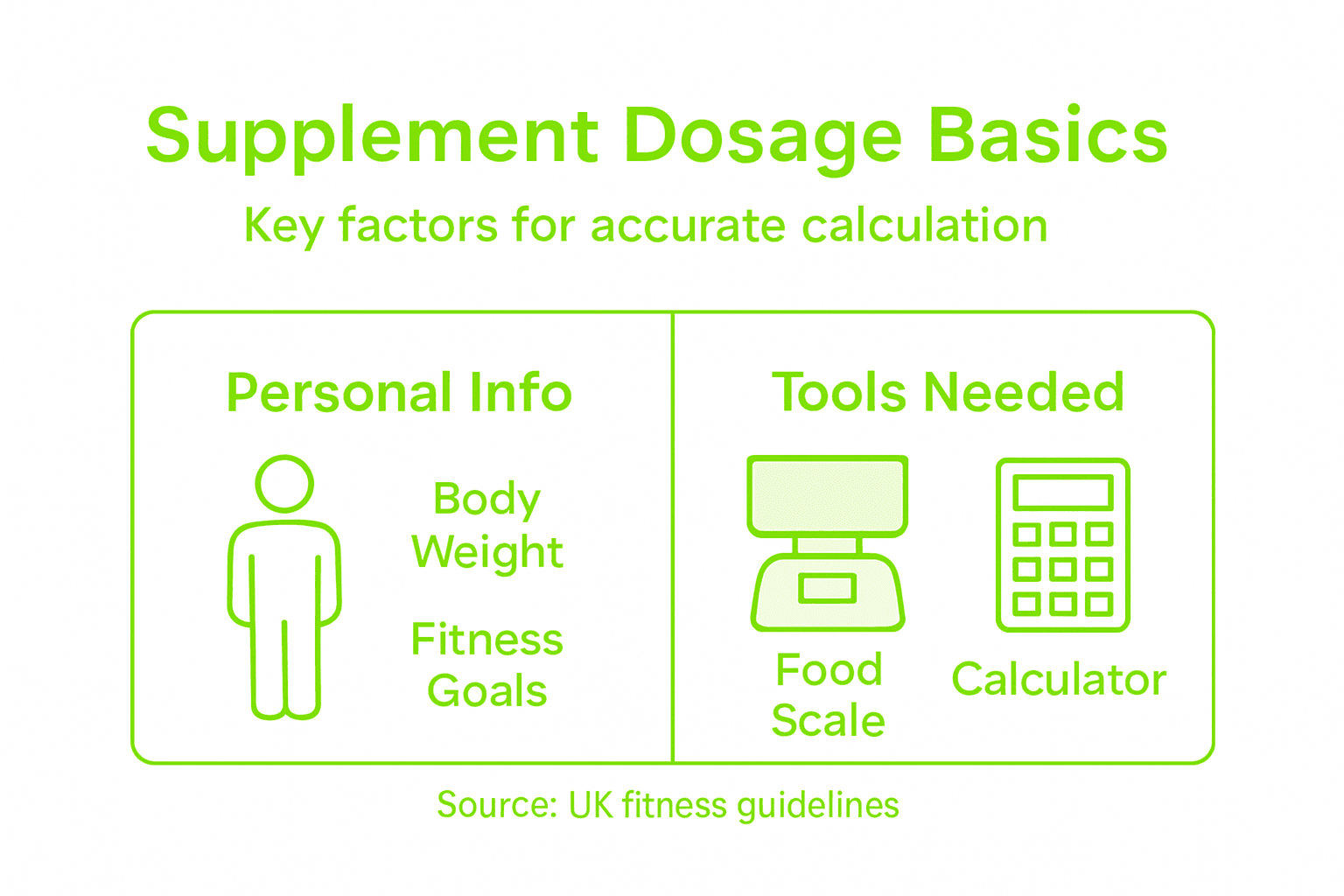
- Determine your current body weight in kilograms
- Assess your training intensity and fitness goals
- Consider your specific metabolic needs
- Factor in your overall dietary protein intake
- Calculate supplement requirements based on nutritional gaps
- Adjust dosages progressively based on performance feedback
Individual supplement needs are as unique as your fingerprint.
For more specialised supplements like iron, clinical dosage calculations become even more critical. Body weight-based dosing allows for precise nutritional support while minimising potential side effects. Professional guidance from a sports nutritionist can help you develop a personalised supplementation protocol that accounts for your individual physiological requirements.
Pro tip: Invest in a digital food scale and body composition calculator to track your measurements with scientific precision, enabling more accurate supplement dosage adjustments.
Step 4: Plan supplement timing for maximum effectiveness
Optimising supplement intake is a strategic science that goes far beyond simply consuming nutrients. The precise moment you introduce specific supplements can dramatically influence their absorption, effectiveness, and overall impact on your fitness performance and recovery.
Sports nutrition timing principles reveal critical windows of opportunity for nutrient intake. Your supplement strategy should synchronise seamlessly with your training schedule, ensuring each nutritional intervention delivers maximum physiological benefit.
Key timing considerations for supplement consumption:
- Pre-workout (30-60 minutes before exercise)
- Immediate post-workout recovery window
- Between meals for sustained nutritional support
- Before bedtime for overnight muscle repair
- Aligned with your specific training intensity
- Coordinated with individual metabolic rhythms
Precision timing transforms supplements from mere nutrients to performance accelerators.
Managing supplement risks becomes crucial when developing your intake strategy. Systematic supplement scheduling helps prevent potential interactions and ensures optimal absorption. Professional athletes understand that timing isn’t just about when you take supplements, but how your body’s physiological state can enhance or diminish their effectiveness.
Pro tip: Use a digital fitness tracking app to log your supplement intake times and correlate them with workout performance, creating a personalised nutritional intervention map.
Below is a comparison of supplement timing strategies and their primary effects:
| Timing Strategy | Example Supplement | Primary Benefit |
|---|---|---|
| Pre-workout | Caffeine, Creatine | Increased energy, focus |
| Post-workout | Whey protein | Faster recovery, muscle repair |
| Bedtime | Casein protein | Sustained protein delivery overnight |
| Between meals | BCAAs | Supports muscle retention |
Step 5: Verify dosage and adjust according to progress
Tracking and adapting your supplement strategy is a dynamic process that demands continuous monitoring and intelligent refinement. Effective supplementation is not a static prescription, but an evolving approach that responds to your body’s changing requirements and fitness progression.
Exercise programme evaluation standards emphasise the importance of systematic progress tracking. Your supplement dosage should be a flexible framework that adapts to your evolving physiological responses, performance metrics, and overall fitness development.
Key strategies for dosage verification and adjustment:
- Monitor physical performance indicators
- Track body composition changes
- Record energy levels and recovery rates
- Assess workout intensity and endurance
- Note any physiological side effects
- Compare results against initial fitness goals
Supplement effectiveness is a conversation between your body and your nutrition strategy.
Goal-setting and progress review requires a methodical approach to measurement. Professional athletes understand that supplement efficacy is not about rigid adherence, but intelligent adaptation. Regular blood tests, performance metrics, and subjective wellness assessments provide comprehensive insights into your nutritional intervention’s effectiveness.
Pro tip: Create a digital dashboard or spreadsheet to systematically log supplement intake, performance metrics, and physiological responses, enabling data-driven nutritional adjustments.
Unlock Your Fitness Potential with Precise Supplementation
Understanding your unique fitness goals and calculating the right supplement dosages can feel overwhelming. This guide highlights how precision in supplement timing and dosage is key to maximising performance, muscle growth, fat loss, and recovery. Many also struggle with choosing high-quality supplements that genuinely support their ambitions without risks or guesswork.
At MyGymSupplements.shop, we empower you to overcome these challenges with our expertly curated range of products. Whether you are targeting muscle gain with premium whey protein or enhancing endurance through carefully selected pre-workouts, we make it easy to find supplements tailored to your needs. Explore our collection to match your goals accurately and take confident steps towards measurable progress.
Dont leave your supplement strategy to chance Discover supplements specifically designed for your training demands and body weight now at MyGymSupplements.shop. Achieve optimal results backed by quality and precision starting today.
Frequently Asked Questions
How do I determine the right supplement dosages for my fitness goals?
To determine the right supplement dosages, first assess your body weight and fitness objectives. For example, start with 0.75g of protein per kilogram of body weight and adjust based on training intensity and dietary intake.
What factors should I consider when selecting supplements?
When selecting supplements, consider your specific fitness goals, current nutritional gaps, and training frequency. Evaluate how each supplement aligns with your desired outcomes, such as muscle gain or endurance improvement.
How often should I adjust my supplement dosages?
You should adjust your supplement dosages regularly based on your performance progress and any changes in your fitness levels. For instance, review and potentially adjust your intake every 4-6 weeks to ensure it meets your evolving physiological needs.
What is the best timing for taking supplements to enhance performance?
The best timing for taking supplements is often around your workout schedule. For optimal effectiveness, consider taking pre-workout supplements 30-60 minutes before exercise and post-workout supplements immediately after to aid recovery.
How can I track my supplement effectiveness?
To track supplement effectiveness, monitor your performance indicators, energy levels, and recovery rates. Keep a detailed log of your supplement intake alongside your training outcomes to identify patterns and areas for adjustment.
Should I consult a nutrition professional for my supplement plan?
Yes, consulting a nutrition professional can provide tailored supplement recommendations based on your specific fitness assessment. This expert guidance ensures your supplementation strategy is customised to your individual needs and goals.

0 comments