

TL;DR:
- A structured, science-backed plan focusing on proper training, nutrition, and recovery is essential for muscle gain.
- Progressive overload, compound exercises, and consistent tracking are key to steady muscle growth.
- Proper diet with a moderate calorie surplus and adequate protein is more effective than supplements alone.
Spinning your wheels in the gym, training hard every week but seeing little change in the mirror, is one of the most demoralising experiences in fitness. The problem is rarely effort. It is almost always the absence of a structured, science-backed plan. Muscle growth does not happen by accident. It demands the right training stimulus, precise nutrition, and smart supplement choices working together. This guide walks you through every stage: what you need before you begin, how to set up your training week, how to fuel growth through food, which supplements are genuinely worth taking, and how to track progress without losing your mind.
Table of Contents
- What you need to start a muscle gain plan
- Step-by-step: Structuring your training for muscle gain
- How to optimise your nutrition for muscle growth
- Supplements: What works, what to avoid, and when to use them
- Common pitfalls and how to track your muscle gain progress
- What most muscle gain guides miss: The power of patience and personalisation
- Take the next step with proven supplements
- Frequently asked questions
Key Takeaways
| Point | Details |
|---|---|
| Progressive training | Use compound lifts and increase weight or reps each week for best results. |
| Nutrition priorities | Stay in a moderate calorie surplus and hit your protein target daily to maximise muscle growth. |
| Smart supplement use | Creatine and whey protein are most effective; skip overhyped products unless there’s a clear deficiency. |
| Track and adapt | Measure strength, muscle size, and adjust your plan based on actual progress, not just the scale. |
What you need to start a muscle gain plan
Now that we have established why structure is essential, let us break down exactly what is needed to begin a muscle gain plan. Before you lift a single weight, getting the foundations right will save you months of wasted effort.
The first foundation is mindset. Muscle building is a slow process measured in months and years, not days. A growth mentality means accepting that consistency beats intensity every single time. Missing one session is fine. Missing ten because you burnt out is not.
Next, assess your readiness. If you have any joint issues, cardiovascular concerns, or have been sedentary for a long period, a quick check-in with your GP before starting is sensible. Most healthy adults can begin resistance training safely, but knowing your baseline matters.
You also need basic equipment and knowledge. You do not need a fully kitted commercial gym to start. Resistance bands, a set of adjustable dumbbells, or access to a barbell and rack will cover the essentials. Learn the major muscle groups (chest, back, legs, shoulders, arms, core) and focus on mastering fundamental movement patterns before adding load.
Beginners should follow a structured resistance training programme with compound exercises and progressive overload from day one.
Starter checklist before you begin:
- Growth mindset and realistic expectations
- Medical clearance if required
- Access to resistance equipment (gym, home weights, or bands)
- Basic understanding of major muscle groups and compound lifts
- A training log or app to record sessions
- Knowledge of calorie surplus essentials for muscle growth
| Requirement | Minimum standard | Ideal standard |
|---|---|---|
| Equipment | Resistance bands or dumbbells | Full gym or barbell set |
| Knowledge | Basic compound movements | Form coaching or video review |
| Nutrition awareness | Know your maintenance calories | Track macros daily |
| Recovery | 7 hours sleep minimum | 8 hours plus active recovery |
Pro Tip: Do not wait until everything is perfect to start. A simple plan executed consistently will always outperform a perfect plan that never begins.
Step-by-step: Structuring your training for muscle gain
With your basics in place, it is time to map out your muscle-building training week. Structure is what separates people who make steady progress from those who plateau after six weeks.
Research consistently points to 4 to 10 sets per muscle group per week as the sweet spot for beginners, using compound lifts, 8 to 12 reps, and progressive overload across 3 to 4 sessions weekly.
How to set up your training week:
- Choose your core exercises. Prioritise compound movements: squats, deadlifts, bench press, rows, and overhead press. These recruit multiple muscle groups simultaneously and drive the most growth.
- Decide on a routine structure. Full-body sessions work brilliantly for beginners training three times per week. If you train four days, an upper/lower split becomes more practical.
- Plan your session order. Alternate muscle groups where possible to allow adequate recovery. Never train the same muscle group on consecutive days.
- Apply progressive overload. Each week, aim to add a small amount of weight, an extra rep, or an additional set. This is the engine of muscle growth. Understanding bulking vs cutting explained will help you align your training phase with your nutrition.
- Log everything. Record weights, sets, and reps after every session. If you are not tracking, you are guessing.
| Routine type | Best for | Frequency | Key benefit |
|---|---|---|---|
| Full-body | Beginners (0 to 12 months) | 3x per week | Maximum frequency per muscle |
| Upper/lower split | Intermediate beginners | 4x per week | Higher volume with recovery |
| Push/pull/legs | Advanced beginners | 5 to 6x per week | Specialised volume per group |
For a ready-made structure, a solid beginner workout plan can provide a reliable starting framework to build from.
Pro Tip: Spend your first four weeks mastering form before chasing heavier weights. Poor technique limits long-term gains and increases injury risk significantly.
How to optimise your nutrition for muscle growth
Training is only half the equation. Let us detail exactly what your nutrition must look like to see results. You can train perfectly and still make zero progress if your diet is working against you.
The cornerstone of muscle gain nutrition is a moderate calorie surplus of 250 to 500 kcal per day above maintenance, with protein sitting at 1.6 to 2.2 grams per kilogram of bodyweight daily. Going higher on calories does not accelerate muscle growth. It accelerates fat gain.
Key insight: A controlled surplus paired with adequate protein is the most reliable driver of lean muscle gain. Excess calories beyond the muscle-building threshold are stored as fat, not converted into additional muscle tissue.
Your macronutrient targets should look roughly like this:
- Protein: 1.6 to 2.2g per kg of bodyweight
- Carbohydrates: 3 to 5g per kg (primarily for training energy)
- Fats: 0.5 to 1g per kg (for hormonal health and joint function)
Interestingly, carbohydrate intake does not independently enhance muscle hypertrophy beyond meeting your energy and protein needs. Carbs matter for fuelling your sessions, not for directly building muscle.
| Bodyweight | Daily calories (surplus) | Protein target | Carbohydrate target |
|---|---|---|---|
| 60 kg | 2,300 to 2,600 kcal | 96 to 132g | 180 to 300g |
| 80 kg | 2,800 to 3,200 kcal | 128 to 176g | 240 to 400g |
| 100 kg | 3,300 to 3,800 kcal | 160 to 220g | 300 to 500g |
Spread your protein across three to five meals per day to maximise muscle protein synthesis. Pair this with a clean bulking approach to minimise unnecessary fat gain while building lean tissue. For a detailed breakdown of hitting your targets, a structured nutrition guide for muscle gain is an excellent reference. You can also use calorie and macro planning tools to personalise your targets accurately.

Supplements: What works, what to avoid, and when to use them
With your meals sorted, should you reach for a supplement tub? Let us separate proven aids from wasted money.
The honest answer is that most supplements are unnecessary if your diet is solid. A small handful, however, are backed by enough evidence to be genuinely useful. Creatine monohydrate at 3 to 5g per day is the most well-supported supplement for strength and muscle mass gains in existence.
The numbers are striking. Over 500 studies on creatine consistently show 1 to 2 kg of additional lean mass over 8 to 12 weeks compared to placebo. Whey protein also outperforms alternatives in meta-analyses for supporting muscle protein synthesis. Evidence on collagen and whey continues to develop, though whey remains the gold standard for post-training recovery.
Evidence-based vs overhyped supplements:
- Worth it: Creatine monohydrate, whey protein (if dietary protein is insufficient), caffeine for performance
- Situationally useful: Casein protein (slow-release, useful before bed), vitamin D if deficient
- Overhyped: BCAAs (redundant if protein intake is adequate), mass gainers (often excess sugar and calories), testosterone boosters (minimal evidence)
The right approach is diet first, supplements second. Once you are consistently hitting your protein and calorie targets through food, adding a creatine supplementation guide to your routine is a logical next step. For a broader view of how products work together, the science of supplement use is worth reading before you spend a penny.
Pro Tip: Stack creatine and whey protein together for the best synergy. Creatine drives strength and cell hydration; whey delivers the amino acids needed for repair and growth.
Common pitfalls and how to track your muscle gain progress
Finally, let us ensure you avoid the traps that derail so many muscle gain journeys and that you know whether you are on the right track.
Remember: Beginners gain fastest in the first months, with optimal volume sitting at 4 to 10 sets per muscle per week. Over-40s benefit from joint-friendly exercise selection to sustain long-term progress.
The most common mistakes and how to fix them:
- Skipping rest days. Muscle is built during recovery, not during the session itself. Two rest days per week minimum is non-negotiable.
- Chasing the scale. Weight fluctuates daily due to water, food, and glycogen. Track body measurements and strength progression instead.
- Poor form under heavy load. Ego lifting leads to injury, not gains. Drop the weight, fix the pattern, then build back up.
- Under-eating protein. Many beginners hit their calories but fall short on protein. Log your food for at least two weeks to identify gaps.
- Changing the plan too soon. Give any programme at least eight weeks before judging its effectiveness. Consistency is the variable most people underestimate.
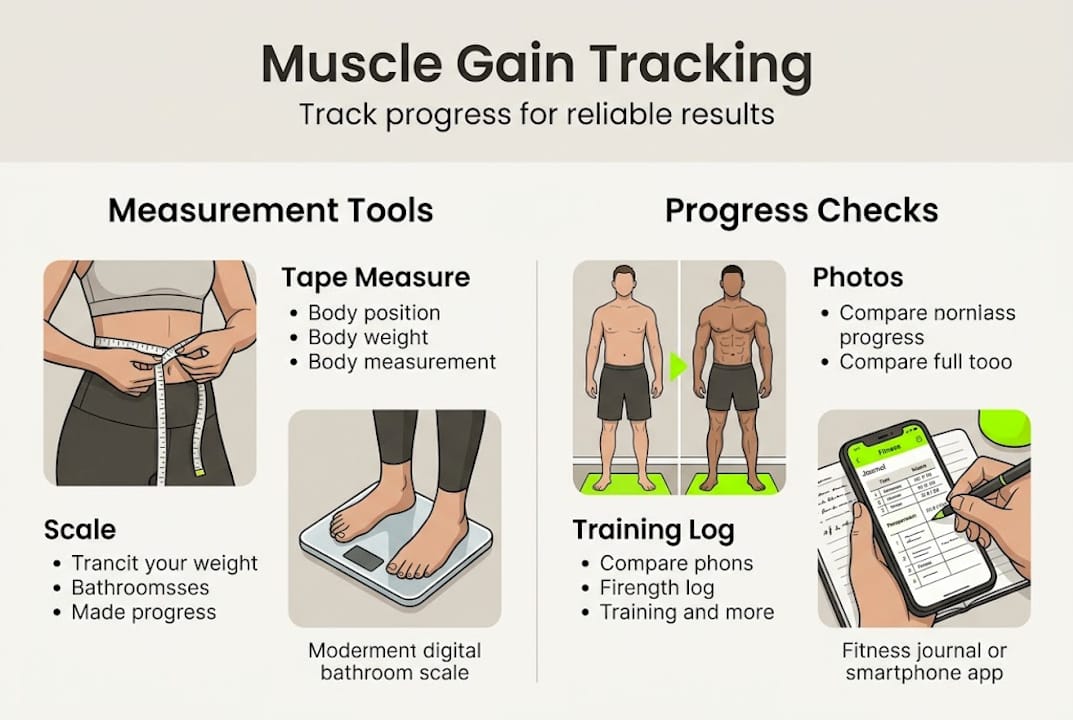
For tracking, use a combination of weekly photos, a tape measure around key areas (chest, arms, waist, thighs), and your training log. Strength improvements are often the earliest reliable signal of muscle growth. Understanding how bulking builds muscle at a physiological level helps you interpret your progress more accurately. For those wanting to understand the science behind training volume research, the evidence clearly supports moderate, consistent volume over excessive short-term effort.
What most muscle gain guides miss: The power of patience and personalisation
Most muscle gain guides hand you a plan and send you on your way. What they rarely acknowledge is that rigid adherence to any single formula is often the reason people quit within weeks.
Life intervenes. Work gets hectic, sleep suffers, motivation dips. The people who build the most muscle over years are not the ones who followed a plan perfectly for eight weeks. They are the ones who adapted, adjusted, and kept showing up. Results vary enormously between individuals based on genetics, sleep quality, stress levels, and training history.
The real skill is learning to read your own body’s feedback. If you are gaining weight too quickly, trim the surplus. If your lifts have stalled for three weeks, add a set or adjust your sleep. Understanding your own calorie surplus needs is far more valuable than following someone else’s numbers blindly.
Do not stress about small weekly fluctuations. Focus on the trend over eight to twelve weeks. That is where the truth lives.
Take the next step with proven supplements
With your muscle gain blueprint in hand, here is how you can equip yourself for the journey. The steps in this guide give you the structure. The right supplements help you close the gap between effort and results, particularly when diet alone cannot fully cover your needs.
Creatine and whey protein are accessible, affordable, and backed by more evidence than any other products on the market. Whether you are just starting out or refining an existing plan, choosing quality matters. Browse and discover trusted muscle-building supplements at MyGymSupplements.shop, where you will find a curated range of proteins, creatine, and recovery aids chosen to support every stage of your muscle gain journey.
Frequently asked questions
How quickly can I expect to see muscle gains as a beginner?
Beginners can typically gain 1 to 2 kg of muscle in the first few months when following a structured resistance training plan with adequate nutrition.
Is creatine safe and effective for muscle gain?
Creatine monohydrate is one of the most researched supplements available, and 3 to 5g daily is consistently shown to be both safe and effective for increasing muscle mass and strength.
Can I gain muscle without supplements if my diet is good?
Absolutely. Supplements are not required if you consistently hit 1.6g of protein per kg or more through whole foods and maintain a calorie surplus.
Do carbohydrates actually help build more muscle?
Carbohydrates fuel your training sessions effectively, but no significant effect on muscle hypertrophy has been found when protein and total calories are already sufficient.
What is the most common mistake people make when starting a bulk?
Eating too aggressively in a calorie surplus is the most frequent error, leading to excess fat gain. A clean bulk approach with a modest 250 to 500 kcal surplus keeps fat gain minimal while supporting lean muscle growth.

0 comments