

TL;DR:
- Supplements support muscle growth only when training, diet, and recovery are already optimal.
- Protein, creatine, and amino acids enhance gains but are not substitutes for fundamentals.
- Building consistent habits and addressing basic factors yield more progress than premium supplements.
Supplements do not build muscle on their own. That might sound blunt, but it is the single most important thing to understand before you spend another penny on protein powder or creatine. The fitness industry generates billions each year by selling the idea that the right product will unlock dramatic gains, yet the research tells a more nuanced story. What the latest evidence actually shows is that protein, creatine, and amino acid supplements can meaningfully support muscle growth, but only when your training, diet, and recovery are already doing the heavy lifting. This article breaks down exactly what works, for whom, and why.
Table of Contents
- Understanding the muscle-building process
- Protein supplements: When and why they work
- Creatine: The powerhouse enhancer for muscle gain
- Amino acids and BCAAs: Essential, but often misunderstood
- Why supplement strategies still miss the point
- Ready to upgrade your supplement routine?
- Frequently asked questions
Key Takeaways
| Point | Details |
|---|---|
| Protein targets matter | Supplements help most if daily protein falls below 1.6g per kilogram of body weight. |
| Creatine fuels gains | Science backs creatine as the most effective and safest mass-building supplement beyond protein. |
| BCAAs are misunderstood | BCAAs rarely boost muscle gain if you already eat enough high-quality protein. |
| Consistency trumps products | No supplement replaces the impact of steady training, diet and recovery. |
Understanding the muscle-building process
Muscle growth, or hypertrophy, is not a mystery. It follows a clear biological process that every serious lifter needs to understand before reaching for a supplement. When you train hard, you create mechanical tension and micro-damage in muscle fibres. Your body responds by increasing muscle protein synthesis (MPS), the process of building new protein structures within the muscle. When MPS consistently exceeds muscle protein breakdown over time, your muscles grow.
The key drivers of MPS are resistance training and dietary protein, specifically essential amino acids (EAAs). Leucine, in particular, acts as a molecular trigger that tells your body to start building. MPS drives muscle gain, stimulated by both training stimulus and EAA availability, which is why neither training nor nutrition alone is ever the full answer.
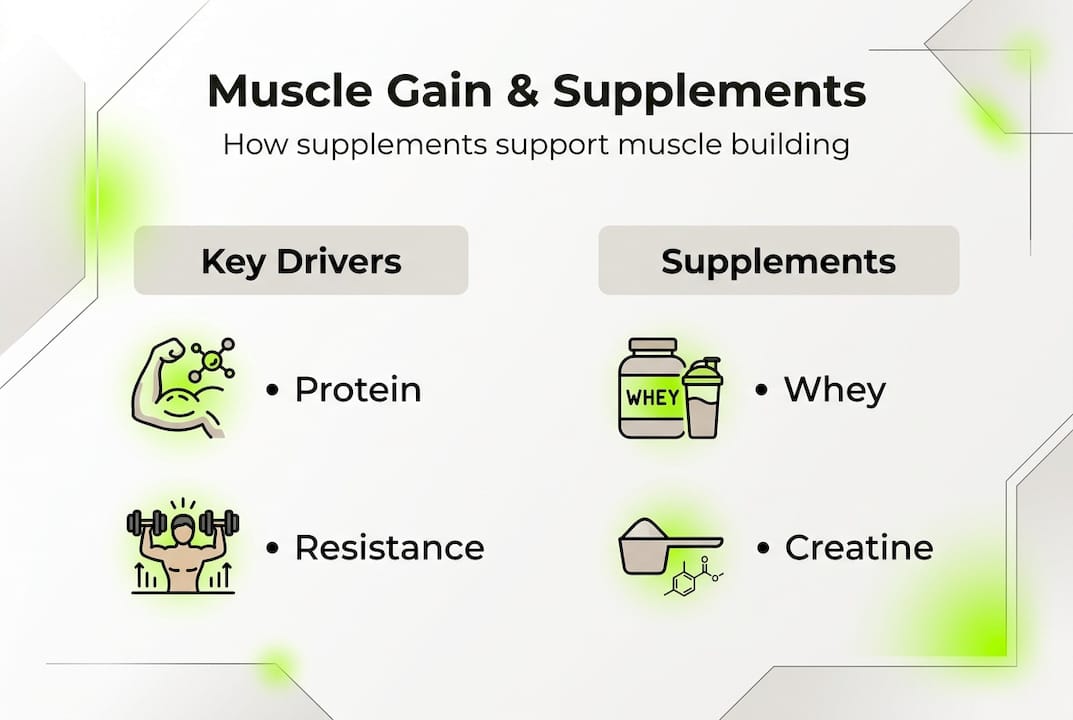
Here is how the main factors stack up:
| Factor | Role in muscle gain | Impact level |
|---|---|---|
| Resistance training | Triggers MPS and mechanical adaptation | Very high |
| Dietary protein | Provides EAAs to fuel MPS | Very high |
| Creatine | Replenishes phosphocreatine for greater training volume | High |
| Sleep and recovery | Allows MPS to occur uninterrupted | High |
| Supplement timing | Optimises MPS windows | Moderate |
Creatine deserves a special mention here because it works differently from protein. Rather than directly feeding MPS, it replenishes phosphocreatine stores in your muscles, giving you more energy for high-intensity efforts. More reps, more weight, more volume. That extra training stimulus is what indirectly drives hypertrophy.
Key things to keep in mind about the muscle-building process:
- Progressive overload is non-negotiable. Without it, no supplement will produce meaningful results.
- A calorie surplus, even a modest one, supports the energy demands of building new tissue.
- Protein distribution across the day matters as much as total intake.
- Sleep is when the majority of muscle repair and growth actually occurs.
“The foundation of muscle gain is always training and nutrition. Supplements are tools that can sharpen the edge, not replace the blade.”
Once you have the fundamentals in place, targeted supplementation can genuinely move the needle. Without them, you are wasting money.
Protein supplements: When and why they work
Protein supplements are the most widely used ergogenic aid in bodybuilding, and for good reason. They are one of the few supplements with consistent, robust evidence behind them. But they are not universally necessary for everyone.
Protein supplements boost MPS and enhance lean mass gains when total intake is suboptimal. The operative phrase there is suboptimal intake. If you are already hitting your protein targets through whole food, adding a shake on top will not magically produce extra muscle.
The evidence-based daily protein target for muscle gain is 1.6 to 2.2 grams per kilogram of body weight. For an 85 kg lifter, that is roughly 136 to 187 grams per day. Many people, even dedicated gym-goers, fall short of this consistently. That is where whey protein earns its place.
Why whey specifically? It is rapidly absorbed, extremely rich in EAAs, and has one of the highest leucine contents of any protein source. Post-workout, when your muscles are primed to absorb nutrients, whey delivers exactly what is needed, fast.
Meta-analyses report an average of +0.45 kg additional lean mass gained when protein supplements are used alongside a resistance training programme compared to training alone. That might sound modest, but compounded over months it is significant.
Here is a practical dosing framework:
- Calculate your target: multiply your bodyweight in kg by 1.6 (minimum) to 2.2 (maximum).
- Divide that total across 3 to 5 meals or shakes throughout the day.
- Aim for 30 to 40 grams of protein per serving to maximise MPS per meal.
- Use whey post-workout and consider casein before bed for overnight recovery.
- Track your intake for at least two weeks to identify genuine gaps.
For those newer to structuring their supplement stack, beginner workout supplements can help clarify where protein fits alongside other essentials.
Pro Tip: Even experienced lifters often front-load protein at dinner and skimp at breakfast. Spreading intake evenly across the day produces better MPS responses than one or two large protein meals.
Creatine: The powerhouse enhancer for muscle gain
If protein is the most popular supplement, creatine is the most validated. Decades of research, hundreds of studies, and a consistent track record make it the gold standard ergogenic aid for strength and muscle gain.

Creatine boosts phosphocreatine stores, strength, and muscle size, and it is most effective for untrained individuals or those performing high-intensity training. The mechanism is straightforward: more phosphocreatine means faster ATP regeneration, which means more reps at heavier weights before fatigue sets in.
The numbers speak clearly:
- Strength improvements of 5 to 15% are commonly reported in studies.
- Lean body mass gains of 1 to 2 kg over supplementation periods are typical.
- Benefits are most pronounced in beginners and intermediate lifters.
- Highly trained athletes with already-optimised diets see smaller but still meaningful gains.
Dosing options:
Loading phase (optional): 20 grams per day split into four doses for 5 to 7 days. This saturates muscle stores quickly.
Maintenance phase: 3 to 5 grams per day. This is sufficient for most lifters and avoids the digestive discomfort some people experience with loading.
Skipping the loading phase and going straight to 3 to 5 grams daily still works. It simply takes 3 to 4 weeks to fully saturate stores rather than one week. For most people, patience is the smarter choice.
For a deeper look at the evidence behind a specific product, the breakdown of creatine monohydrate benefits is worth reading.
Pro Tip: Take creatine alongside a meal containing carbohydrates or protein. Insulin release from these nutrients enhances creatine uptake into muscle cells, making each dose more effective.
Amino acids and BCAAs: Essential, but often misunderstood
BCAAs (branched-chain amino acids: leucine, isoleucine, and valine) are heavily marketed in the fitness world. The science, however, tells a more complicated story than the labels suggest.
Leucine is the star of the show. It activates the mTOR signalling pathway, which is the primary molecular switch for MPS. This is why leucine-rich protein sources are so effective for muscle building. The logic of BCAA supplements follows from this: if leucine triggers MPS, surely supplementing BCAAs directly will amplify gains?
BCAAs boost MPS via mTOR, but pure BCAA supplements rarely drive further muscle gain if protein intake is already adequate. The reason is that BCAAs alone cannot sustain MPS without the other EAAs. You trigger the process but cannot complete it without the full complement of amino acids.
Where BCAAs do show genuine value:
- Reducing delayed onset muscle soreness (DOMS) after intense sessions.
- Providing a muscle-sparing effect during fasted training or calorie deficits.
- Offering a low-calorie option to support recovery between meals.
- Potentially reducing central fatigue during very long training sessions.
For broader recovery support, understanding BCAAs for recovery and how to use BCAA supplements correctly makes a real difference. If you want to go further, best amino acids for athletes covers the broader EAA picture.
“A complete essential amino acid formula will almost always outperform a pure BCAA product for muscle building, because it provides everything MPS needs to run to completion.”
Pro Tip: Use BCAAs before or during training only if you are training fasted or in a significant calorie deficit. If you have eaten a protein-rich meal within two hours of training, BCAAs add very little.
Why supplement strategies still miss the point
Here is something that years of working with bodybuilders and serious lifters has made clear: most people plateau not because they are missing the right supplement, but because they are missing progressive overload, consistent sleep, or enough total calories. They chase the next trending product instead of auditing the basics.
The supplement industry is brilliant at creating urgency around novelty. A new amino acid formula, a proprietary creatine blend, a next-generation protein matrix. The reality is that the fundamentals have not changed. Whey, creatine monohydrate, and a solid diet built around whole foods will outperform any exotic stack for the vast majority of lifters.
We have seen clients spending £150 a month on supplements while sleeping six hours a night and eating inconsistently. The supplements were not the problem or the solution. Fixing sleep and dietary consistency delivered more progress in eight weeks than any product ever had.
The smartest approach is to treat supplements as precision tools, not foundations. Build your training programme, nail your nutrition, protect your sleep, then layer in evidence-based supplements where genuine gaps exist. If you are just starting out, starter supplement advice will help you avoid the common trap of over-supplementing before the basics are sorted.
Ready to upgrade your supplement routine?
Putting the evidence into practice starts with choosing products that actually deliver what they promise. At MyGymSupplements, the focus is on science-backed supplements with transparent labelling and clinically validated doses. No proprietary blends that hide ingredient quantities. No hype-driven formulas built around trends rather than research.
Whether you are looking to close a protein gap with a high-quality whey, start a creatine protocol, or find the right amino acid formula for your training style, the range is built around what the evidence supports. Browse by goal, by category, or by ingredient to find exactly what fits your current programme. Smart supplementation starts with the right information, and the right products.
Frequently asked questions
How much protein do I really need to build muscle?
Optimal protein intake sits at 1.6 to 2.2 grams per kilogram of body weight per day, ideally split across 3 to 5 meals to maximise MPS throughout the day.
Is creatine safe for long-term use?
Yes. Creatine monohydrate has a strong safety record across decades of research and is considered safe for most healthy adults at recommended doses of 3 to 5 grams daily.
Are BCAA supplements necessary if I eat enough protein?
No. BCAA supplements provide little additional benefit for muscle gain or strength if your total dietary protein is already adequate, though they may help reduce soreness.
Do supplements matter more for beginners or advanced athletes?
Untrained individuals and those with suboptimal diets see the greatest benefit from supplementation. Seasoned bodybuilders with already-optimised nutrition tend to experience smaller, more marginal gains from the same products.

0 comments