

TL;DR:
- Intra-workout supplements support prolonged, intense, or fasted training by maintaining energy and hydration.
- Most effective for sessions over 90 minutes, high-volume, high-intensity, or in hot climates.
- Key ingredients include fast carbs, EAAs, electrolytes, with effectiveness depending on training demands.
Most gym-goers assume intra-workout supplements are reserved for elite endurance athletes or competitive bodybuilders. That assumption costs people real performance gains. The truth is that whether these products benefit you depends almost entirely on how long you train, how hard you push, and what you ate beforehand. Not every session demands them, but the right session absolutely does. This guide cuts through the marketing noise to explain what intra-workout supplements actually contain, who genuinely benefits, which ingredients matter most, and what the science really supports, so you can make smarter decisions for every training block.
Table of Contents
- What intra-workout supplements are and how they work
- When and for whom are intra-workout supplements most effective?
- Key ingredients: what to look for in a quality intra-workout supplement
- Evidence, limitations, and industry debate: what the research really shows
- Our perspective: focus on fit, not marketing
- Find your ideal intra-workout strategy
- Frequently asked questions
Key Takeaways
| Point | Details |
|---|---|
| Most vital for long sessions | Intra-workout supplements matter most for training lasting over 90 minutes or at high volume. |
| Carbs and EAAs work best | The most reliable ingredients are fast-absorbed carbohydrates and essential amino acids, not fancy blends. |
| Not needed every workout | Skip intra-workout products for short, lower-intensity, or pre-fed sessions unless conditions demand hydration support. |
| Industry marketing overstates need | Most exercisers benefit more from timing and total nutrition than supplements marketed as essentials. |
| Personalise your approach | Assess your session demands and nutrition first—then add intra-workout support if evidence and experience fit. |
What intra-workout supplements are and how they work
Intra-workout supplements are products consumed during exercise, not before or after. That distinction matters because the physiological demands mid-session are quite different from what your body needs at rest. While pre-workout products prime your nervous system and post-workout nutrition drives recovery, intra-workout formulas serve a specific role: keeping your body fuelled, hydrated, and protected while the work is actually happening.
As intra-workout nutrition research confirms, these supplements consist of amino acids, carbohydrates, electrolytes, and sometimes creatine or hydrolysed protein, supporting energy, hydration, and performance. Each ingredient targets a different physiological pressure point that builds during prolonged or intense effort.
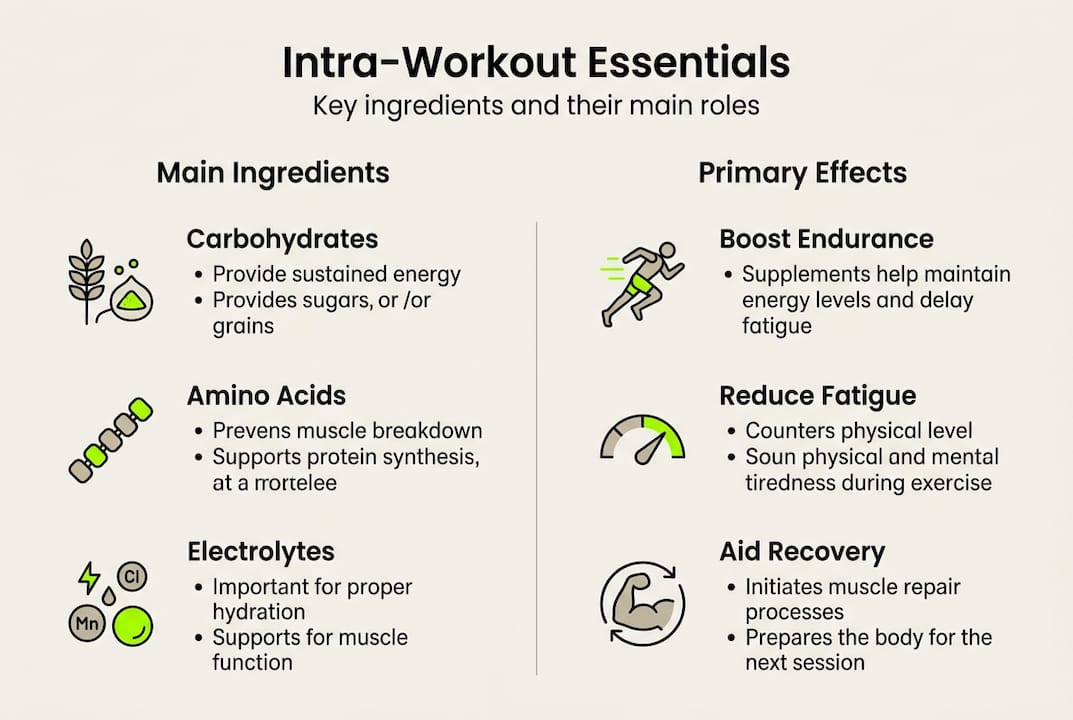
Here is a quick breakdown of the core ingredients and what they do:
| Ingredient | Primary role | Typical dose per hour |
|---|---|---|
| Fast-absorbed carbohydrates | Replenish glycogen, sustain energy | 30–90g |
| EAAs (essential amino acids) | Reduce muscle breakdown | 5–10g |
| BCAAs (branched-chain amino acids) | Signal muscle protein synthesis | 5–10g |
| Electrolytes (sodium, potassium) | Replace sweat losses, maintain hydration | Varies by sweat rate |
| Creatine | Support ATP regeneration for power | 3–5g |
The mechanisms behind these ingredients are straightforward once you understand what goes wrong without them. During long or hard sessions, blood glucose drops, muscle glycogen depletes, and your body begins breaking down muscle tissue for fuel. Supplementing with these nutrients helps maintain energy, reduce muscle breakdown, and replace lost fluids during exercise.
Carbohydrates are arguably the most powerful lever here. Fast-absorbed carbs, particularly a glucose and fructose mix, use two separate intestinal transport pathways, meaning you can absorb more fuel per hour than with glucose alone. Understanding BCAA and EAA benefits also helps, since EAAs provide all the building blocks for muscle protein synthesis, while BCAAs alone cannot complete that process. Electrolytes are the often-overlooked piece; losing just 2% of body weight through sweat can impair performance, making electrolyte support particularly critical in warm training environments.

Carbohydrate intake during prolonged exercise can extend endurance by 20–30%, which is a meaningful edge for anyone pushing past the one-hour mark.
When and for whom are intra-workout supplements most effective?
Knowing what these supplements contain is only half the picture. The more important question is whether you actually need them during your sessions.
Intra-workout supplements are most beneficial for sessions lasting more than 90 minutes, high-volume or high-intensity efforts, endurance events, fasted training, or hot climates. If you tick any of those boxes, the case for using them is solid. If you do not, you may be spending money on something that offers little measurable return.
Here is a comparison of who benefits most versus who can skip them:
| Athlete profile | Likely benefit | Priority ingredient |
|---|---|---|
| Endurance runner (90+ min) | High | Carbs + electrolytes |
| High-volume strength athlete | High | EAAs + carbs |
| Fasted trainer | Moderate to high | EAAs + electrolytes |
| Hot-climate athlete | Moderate | Electrolytes |
| Recreational lifter (60 min, well fed) | Low | None needed |
For those who do benefit, the how matters as much as the what. Follow these steps to get the most from your intra-workout nutrition:
- Begin sipping 15–20 minutes into your session, not at the halfway point.
- Take small amounts every 15–20 minutes rather than large boluses at once.
- Prioritise carbohydrates and EAAs for sessions exceeding 90 minutes.
- Adjust electrolyte intake based on sweat rate and environmental temperature.
- Pair your intra-workout strategy with solid pre and post workout strategies for a complete approach.
For sessions under 60 minutes, especially if well-fed beforehand, benefits are usually negligible. That is not a knock on the products. It simply reflects that your body has enough stored glycogen and circulating amino acids to handle shorter work without additional support.
Pro Tip: If you train first thing in the morning without eating, treat your intra-workout drink as your pre-workout fuel. A mix of fast carbs and EAAs consumed from the first set can make a significant difference to both performance and muscle retention during fasted sessions.
Key ingredients: what to look for in a quality intra-workout supplement
Once you know when intra-workout supplements are worth using, choosing the right formula becomes the next challenge. The market is crowded with products that blend impressive-sounding ingredient lists but vary enormously in quality and dosing.
Evidence supports fast-absorbed carbohydrates at 30–90g per hour, EAAs at 5–10g, creatine optionally, and electrolytes including sodium and potassium for performance, with EAAs more consistently reducing muscle breakdown than BCAAs alone.
Here is what to look for on the label:
- Carbohydrates: A glucose and fructose blend absorbs faster than glucose alone. Look for products using maltodextrin, cluster dextrin, or a dual-source carb blend. Avoid products relying solely on fructose, which can cause gut discomfort at high doses.
- EAAs over BCAAs: BCAAs explained in detail, but the key point is that BCAAs (leucine, isoleucine, valine) are three of the nine essential amino acids. A full EAA profile gives your muscles everything needed for protein synthesis, not just the trigger.
- Electrolytes: Sodium is the most critical electrolyte to replace during sweat loss. Potassium and magnesium support muscle contraction and nerve function. If a product skimps on sodium, it is under-dosed for serious training.
- Creatine (optional): Creatine benefits are well established for power and strength. Adding 3–5g intra-workout is a practical way to maintain daily creatine intake without adding another supplement.
- Avoid proprietary blends: These hide individual ingredient doses behind a total blend weight, making it impossible to verify you are getting effective amounts of each component.
Pro Tip: For sessions over two hours, consider using real food carbohydrates like bananas or dates alongside your intra-workout drink. Whole food sources provide additional micronutrients and can be easier on the stomach than concentrated supplement carbs during very long efforts.
Evidence, limitations, and industry debate: what the research really shows
The science behind intra-workout nutrition is genuinely strong in specific contexts. But the supplement industry has a habit of extrapolating findings from elite endurance research and applying them universally, which is where things get misleading.
“Consuming carbs intra-workout can extend time to exhaustion by 20–30% during prolonged exercise and improve power output by 15–20% in high-volume sessions.”
Those are real, meaningful numbers. But they come from studies on prolonged, high-intensity efforts. The same effects do not transfer to a 45-minute moderate-intensity gym session.
Here is an honest summary of where the evidence stands:
- Strong support: Carbohydrate supplementation during endurance events and high-volume strength training consistently improves performance and delays fatigue.
- Moderate support: EAA supplementation reduces muscle protein breakdown during fasted or very long sessions, though the effect is smaller when total daily protein intake is already high.
- Weak support: Multi-ingredient blends with added vitamins, adaptogens, or proprietary energy matrices rarely outperform simple carb-plus-EAA combinations in controlled studies.
- No support: Evidence does not support benefit in short sessions or for those with sufficient protein; industry often overstates utility for casual or short-duration sessions.
The honest truth about optimising workout nutrition is that simplicity usually wins. A well-dosed carbohydrate source and a complete EAA profile will outperform most elaborate blends at a fraction of the cost.
Our perspective: focus on fit, not marketing
Having worked with athletes across endurance, strength, and team sports, the most common mistake we see is not under-supplementing. It is over-supplementing on sessions that simply do not demand it.
The supplement industry profits from the idea that every workout needs optimising with a product. But real performance gains come from consistency, progressive overload, and smart recovery, not from sipping an expensive drink during a 40-minute weights session when you had a solid meal two hours before.
Where intra-workout supplements genuinely earn their place is in hard, long, or fasted sessions where your body is actually under nutritional stress. That might be your Saturday long run, a two-hour high-volume leg session, or a pre-dawn training block before breakfast. In those moments, the right formula makes a measurable difference.
Our practical advice: test your intra-workout strategy on your hardest sessions first. Use supplement timing advice to dial in when to consume what, and track how you feel and perform. Do not make every session a supplement experiment. Find what works for your most demanding training, then apply it consistently where it counts.
Find your ideal intra-workout strategy
Now that you understand what intra-workout supplements do and where they genuinely deliver, you are in a much stronger position to make evidence-led choices for your training. The next step is putting that knowledge into practice with the right products. At MyGymSupplements.shop, you will find an evidence-led range of amino acids, carbohydrate formulas, and electrolyte products curated for athletes who train seriously. Browse by goal or ingredient to find what fits your sessions, and revisit our guides on BCAA benefits, electrolyte support, and supplement timing to build a strategy that actually works for your training demands.
Frequently asked questions
Do I need intra-workout supplements for every training session?
Most people do not need intra-workout supplements for workouts under one hour if they are well fed beforehand. Benefits are negligible for short, moderate-intensity sessions with adequate pre-workout nutrition in place.
What is the most important ingredient in an intra-workout supplement?
Carbohydrates and essential amino acids are the most evidence-backed for sustaining performance and reducing muscle breakdown. Fast-absorbed carbohydrates at 30–90g per hour combined with 5–10g of EAAs form the most effective foundation.
Is it better to use intra-workout supplements or just focus on pre- and post-workout nutrition?
For shorter or less intense sessions, pre- and post-workout nutrition is usually sufficient. Intra-workout supplements are best reserved for prolonged, intense, or fasted training where pre and post nutrition alone cannot bridge the gap.
How should I take intra-workout supplements for best results?
Sip intra-workout drinks every 15–20 minutes during long or high-intensity training. Aim for 40–60g of carbs plus 5–10g EAAs per hour for sessions exceeding 90 minutes.

0 comments