

TL;DR:
- Supplement timing aligns with body physiology shifts around exercise to optimize recovery and performance.
- High-sensitivity supplements require precise timing, while low-sensitivity supplements benefit from consistent daily intake.
- Prioritizing routine and consistency over exact timing yields better long-term training results.
You train hard, eat well, and still feel like your recovery is lagging or your performance has plateaued. Before you overhaul your entire programme, consider this: the when of supplementation may matter just as much as the what. Most athletes know which supplements to take, but far fewer understand how timing can sharpen or blunt their effects. Get it right and you accelerate muscle repair, sustain energy through gruelling sessions, and wake up ready to go again. Get it wrong and you’re leaving real gains on the table. This guide breaks down exactly how to time your supplements for peak effect.
Table of Contents
- Understanding why timing matters
- Pre-, intra-, and post-workout supplements: when and what to take
- Tailoring timing to your training and nutrition
- Common mistakes and how to avoid them
- Why daily habits beat clock-watching for supplement timing
- Optimise your supplement routine with expert support
- Frequently asked questions
Key Takeaways
| Point | Details |
|---|---|
| Timing boosts recovery | Consuming protein and carbohydrates shortly after intense training accelerates muscle repair and replenishes energy. |
| Daily consistency matters | Regularly taking key supplements like beta-alanine yields better results than sporadic or perfectly timed dosing. |
| Personalise for your goals | Adjust supplement timing based on your training type, diet, and individual response for best outcomes. |
| Avoid common pitfalls | Focus on routine and total nutrition rather than obsessing over the precise minute for every supplement. |
Understanding why timing matters
Supplement timing is not about obsessing over the clock to the nearest minute. It is about understanding how your body’s physiology shifts around exercise, and aligning your nutrition to meet those shifts. The most discussed concept here is the anabolic window, the 30 to 60-minute period after intense exercise when your muscles are primed to absorb nutrients and begin the repair process.
During this window, blood flow to muscle tissue is elevated, insulin sensitivity is heightened, and glycogen stores are depleted. Your body is essentially signalling: feed me now. Miss this window consistently and recovery slows, soreness lingers longer, and adaptation to training is blunted.
“Protein and carbohydrate supplementation immediately post-exercise expands recovery and reduces fatigue versus delay.”
This is not just gym folklore. The science is clear that immediate intake of fast-digesting protein and carbohydrates after hard training outperforms delayed intake for reducing fatigue and supporting muscle repair. That said, not every supplement behaves the same way. Some are acutely sensitive to timing; others work through long-term accumulation.
Here is a quick overview of how timing sensitivity varies across common supplement types:
| Supplement | Timing sensitivity | Best approach |
|---|---|---|
| Whey protein | High | Within 30 to 60 minutes post-workout |
| Creatine | Moderate | Daily; close to workout window |
| Beta-alanine | Low | Daily consistency trumps timing |
| Caffeine | High | 30 to 45 minutes pre-workout |
| Simple carbohydrates | High | Intra or immediately post-workout |
| Casein protein | Low | Before sleep for overnight recovery |
Key takeaways on timing sensitivity:
- High sensitivity supplements need precise placement around training to deliver their full benefit.
- Moderate sensitivity supplements still benefit from workout-adjacent timing, but daily totals matter more.
- Low sensitivity supplements are about building up levels in the body over time, not hitting a specific moment.
Understanding this spectrum stops you from treating every supplement like it needs a stopwatch.
Pre-, intra-, and post-workout supplements: when and what to take
Understanding why timing is key leads us to the practical question: when exactly should you use specific supplements?
The most effective approach is to think in three phases: before, during, and after your session. Each phase has distinct physiological demands, and matching the right supplement to each phase is where results compound.
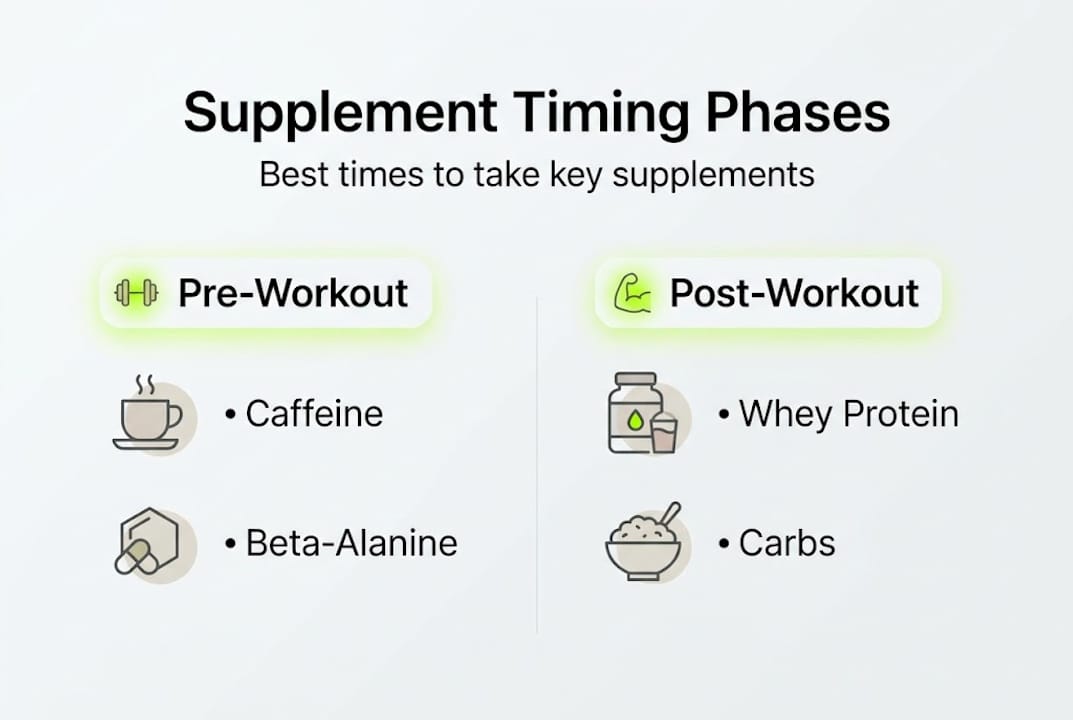
Pre-workout phase (30 to 60 minutes before training)
Caffeine is the standout here. It peaks in the bloodstream roughly 45 to 60 minutes after ingestion, so taking it too late means your session is half over before it kicks in. Creatine taken pre-workout has shown solid benefits, particularly for strength and power output. For a full breakdown, the supplement timing workflow guide maps out exactly when to take each type.
Beta-alanine is often included in pre-workout blends, but its mechanism is different. Beta-alanine daily consistency matters far more than taking it immediately before training. Its buffering effect on muscle acidity builds up over weeks of consistent daily dosing, not from a single pre-session hit.
Intra-workout phase (during training)
For sessions lasting longer than 60 to 75 minutes, or for high-intensity interval training (HIIT), simple carbohydrates become valuable. They provide fast-acting fuel to sustain output when glycogen stores start to dip. Branched-chain amino acids (BCAAs) can also reduce muscle breakdown during prolonged effort.
Post-workout phase (within 30 to 60 minutes after training)
This is the most critical window for most athletes. Fast-digesting whey protein combined with simple carbohydrates is the gold standard. Whey is absorbed rapidly, flooding the muscles with amino acids precisely when they need them most. For a deeper look at how to structure this phase, the guide on pre and post workout supplements covers the full picture.

Here is a practical timing table:
| Phase | Supplement | Timing | Key benefit |
|---|---|---|---|
| Pre-workout | Caffeine | 45 min before | Focus and endurance |
| Pre-workout | Creatine | 30 to 60 min before | Power and strength |
| Intra-workout | Simple carbs | During session | Sustained energy |
| Post-workout | Whey protein | Within 30 to 60 min | Muscle repair |
| Post-workout | Fast carbs | Immediately after | Glycogen replenishment |
| Pre-sleep | Casein protein | 30 min before bed | Overnight recovery |
Pro Tip: If you train early in the morning and cannot stomach a full meal beforehand, a small whey shake with fast carbs immediately post-session does double duty for both pre-sleep recovery and morning replenishment.
- Confirm your session length before choosing intra-workout supplements.
- Set a phone reminder for your post-workout shake so the window does not slip by.
- Separate your caffeine from your creatine if possible to track each supplement’s effect independently.
Tailoring timing to your training and nutrition
Knowing the basics, let’s take it a step further and personalise for your goals and lifestyle.
Not every athlete trains the same way, and timing strategies that work brilliantly for a powerlifter may be suboptimal for a marathon runner. Training type and dietary context both significantly alter how much timing matters for each supplement, and ignoring this leads to a one-size-fits-all approach that underserves your specific goals.
Strength and hypertrophy training
For those focused on building muscle and increasing strength, the post-workout protein window is particularly important. Muscle protein synthesis (MPS) spikes sharply after resistance training. Hitting it with fast-digesting protein and a moderate dose of carbohydrates maximises the anabolic response. Creatine timing also matters more here than it does for endurance athletes.
Endurance and cardio-based training
Longer sessions deplete glycogen stores more aggressively. Intra-workout carbohydrates become a genuine performance tool, not just a nice-to-have. Post-workout recovery should prioritise carbohydrate replenishment alongside protein, with a slightly higher carb-to-protein ratio compared to strength sessions.
Fasted training and low-carb diets
If you train in a fasted state or follow a low-carbohydrate diet, timing becomes even more critical. Carbohydrate depletion amplifies the body’s sensitivity to post-exercise nutrition, meaning that a well-timed post-workout shake can have a disproportionately large recovery benefit. For personalised guidance, the resource on personalised supplement timing is worth bookmarking.
Key factors to consider when personalising your timing:
- Session duration: Longer sessions increase the value of intra-workout nutrition.
- Training goal: Hypertrophy demands more precise post-workout protein timing than general fitness.
- Dietary pattern: Low-carb or fasted athletes benefit more from timely post-exercise carbs.
- Recovery status: If you train twice a day, the post-workout window becomes non-negotiable.
Pro Tip: Keep a simple training log that notes how you felt 24 hours after different timing approaches. Patterns emerge quickly and tell you more than any generic guide can.
For a complete look at how to structure your nutrition around training, the post-workout nutrition guide offers sport-specific breakdowns.
Common mistakes and how to avoid them
Personalisation only works if you avoid classic pitfalls. Here is how to sidestep the most common timing mistakes.
The biggest error most athletes make is treating the post-workout shake as a magic fix while ignoring the rest of their diet. A single well-timed shake cannot compensate for inadequate daily protein intake or poor sleep. The post-workout supplement science is clear: timing amplifies a good foundation, it does not replace one.
“Daily consistency with core supplements matters more than chasing the ‘perfect’ acute timing.”
Another frequent mistake is over-relying on fasted training as a fat-loss strategy while neglecting post-exercise nutrition. Training fasted has its place, but skipping the recovery window afterwards negates much of the muscle-preservation benefit. For a broader look at which supplements deliver real results, effective supplement examples for athletes is a solid reference.
Here are the most common timing mistakes and how to fix them:
- Missing the post-workout window repeatedly: Set a phone alarm for the moment you finish your last set. Make your shake in advance if needed.
- Taking beta-alanine only on training days: Its benefits require daily dosing. Missing rest days breaks the accumulation cycle.
- Loading caffeine too late: Taking your pre-workout 10 minutes before training means you are warming up before it even kicks in.
- Neglecting pre-sleep protein: Casein before bed supports overnight muscle protein synthesis. Many athletes skip this entirely.
- Changing too many variables at once: If you alter timing and switch supplements simultaneously, you will not know what is working.
Building habits around timing is more effective than chasing the perfect moment. Use reminders, prep your shakes in advance, and treat your supplement routine with the same discipline as your training programme.
Why daily habits beat clock-watching for supplement timing
Here is the uncomfortable truth that most sports nutrition content glosses over: the obsession with pinpointing the exact minute to take each supplement is, for most athletes, a distraction from what actually drives progress.
The anabolic window is overstated as a driver of long-term hypertrophy. Yes, it matters for acute recovery, particularly after very intense or prolonged sessions. But the athlete who consistently hits their daily protein targets, sleeps well, and supplements regularly will outperform the one who nails the 30-minute window on some days but is erratic the rest of the time.
We have seen this pattern repeatedly. Athletes who fixate on timing often do so at the expense of consistency. They stress about being five minutes late with their shake. They skip a supplement because they missed the ‘ideal’ window. That mindset is counterproductive.
The smarter approach, which experienced athletes and coaches understand, is to use timing as a framework, not a rigid rule. Build your supplement habits into your daily routine so they happen automatically. Use the limits of the anabolic window as a guide for structuring your day, not as a source of anxiety. When timing and consistency work together, that is when real, sustained progress happens.
Optimise your supplement routine with expert support
Armed with the science, routines, and tips, take the next step by making supplement timing a seamless part of your fitness journey. At MyGymSupplements, we stock a carefully selected range of proteins, pre-workouts, creatine, BCAAs, and recovery supplements, all chosen with performance and evidence in mind. Whether you are building a timing-first supplement stack or simply looking to sharpen what you already use, our product range and in-depth blog guides are designed to support every stage of your training. Browse by goal, explore our best sellers, or reach out to our team for personalised supplement advice. The right products, taken at the right time, make a measurable difference.
Frequently asked questions
Is it really essential to take protein immediately after training?
Immediate post-exercise protein sharply accelerates recovery, but your total daily protein intake is equally important for sustained muscle gains over time.
Does supplement timing differ for strength and endurance sessions?
Yes. Strength versus endurance timing differs notably: strength training prioritises post-workout protein, while endurance sessions demand greater attention to carbohydrate replenishment alongside protein.
How should I take beta-alanine for maximum benefits?
Take beta-alanine in divided daily doses consistently. Beta-alanine’s long-term benefit accumulates over weeks, making daily habit far more important than pre-workout timing.
Can low-carb diets impact my timing needs?
Absolutely. Carb-depleted athletes experience heightened sensitivity to post-training nutrition, making timely carbohydrate and protein intake especially valuable for recovery.
Is the ‘anabolic window’ a myth?
Not entirely. The anabolic window supports acute recovery effectively, but its role in driving long-term muscle growth is less significant than consistent daily supplementation and overall diet quality.
Recommended
- Fitness Supplement Timing Workflow for Peak Performance – MyGymSupplements
- Fitness Supplement Timing Workflow for Peak Performance – MyGymSupplements
- How to Maintain Supplement Schedule for Peak Fitness Results – MyGymSupplements
- How to Maintain Supplement Schedule for Peak Fitness Results – MyGymSupplements

0 comments