

TL;DR:
- Combining plant and whey proteins enhances muscle recovery through rapid and sustained amino acid delivery.
- Strategies include choosing appropriate powders, ratios, and timing to optimize leucine intake post-workout.
- Proper blending improves digestibility, supports dietary preferences, and outperforms single-source protein approaches.
Choosing between plant and whey protein is one of the most common dilemmas athletes face when building a nutrition plan. The frustration is real: you know protein matters, but you’re not sure whether mixing sources is worth the effort, or whether you’re just overcomplicating things. The truth is, combining plant and whey proteins strategically can outperform either source alone for muscle gain and recovery. This guide walks you through exactly why it works, what you need, how to do it correctly, and the mistakes to avoid so you get results from every shake.
Table of Contents
- Understanding the benefits of combining plant and whey proteins
- What you need: Choosing powders, blends, and tools
- Step-by-step: How to combine and prepare your protein blend
- Troubleshooting and common mistakes when combining plant and whey
- Our take: Why the right blend wins over ‘pure protein’ thinking
- Discover more: Find your ideal protein with us
- Frequently asked questions
Key Takeaways
| Point | Details |
|---|---|
| Balanced recovery | Combining plant and whey proteins gives a more complete amino acid profile and sustained muscle repair. |
| Flexible doses | No strict ratio needed—adjust total protein and leucine to match your muscle-building needs. |
| Simple preparation | Mix powders or use pre-formulated blends for easy, effective shakes. |
| Digestive adaptability | Blending helps athletes with dairy sensitivities or mixed diets get optimal protein from both sources. |
Understanding the benefits of combining plant and whey proteins
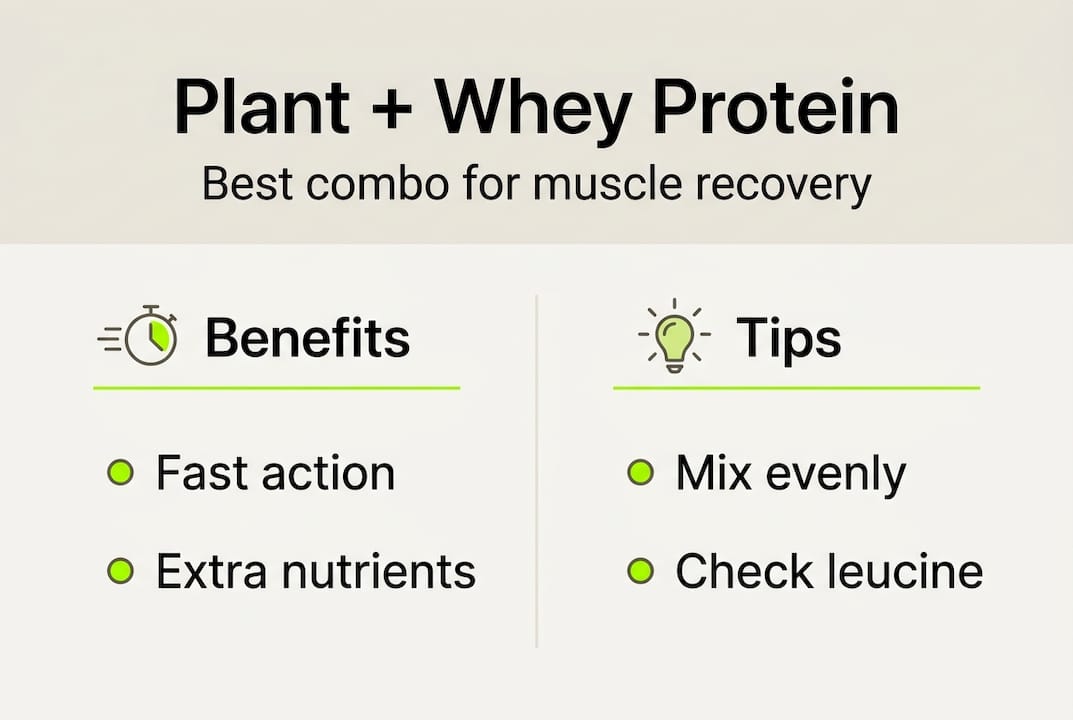
Whey protein is fast-acting. It floods your bloodstream with amino acids quickly after training, triggering a sharp spike in muscle protein synthesis. Plant proteins, by contrast, digest more slowly, releasing amino acids over a longer window. When you combine both, you get the best of each: an immediate anabolic signal followed by sustained delivery of building blocks your muscles need during recovery.
This isn’t just theory. Hybrid soy-dairy protein prolongs amino acid delivery, meaning blending whey and plant proteins enhances amino acid variety, digestibility, and sustained release, prolonging muscle-building stimuli. More recently, plant-based protein blends can match whey for muscle recovery when dosed appropriately, which is a significant finding for athletes who want flexibility in their nutrition.
For athletes with digestive sensitivities, a blend also reduces the burden of a large whey-only dose. Plant proteins such as pea and rice are naturally easier on the gut for many people, and mixing them with whey dilutes the lactose load. This makes the combination suitable for a wide range of athletes, from omnivores who want more variety to those gradually reducing their dairy intake without sacrificing performance.
Here is a quick summary of what each protein type brings to the blend:
- Whey protein: Rapid absorption, high leucine content, strong anabolic spike post-workout
- Pea protein: Slow digestion, rich in arginine, excellent for sustained amino acid release
- Rice protein: Complements pea with a broader amino acid profile, easily digestible
- Soy protein: Complete amino acid profile, supports both fast and moderate release
- Hemp protein: Contains omega-3 fatty acids, beneficial for inflammation and recovery
“A combined protein source that provides both fast and slow amino acid delivery creates a more prolonged anabolic environment than either source alone.”
For athletes looking to go deeper on sports-specific protein strategies, understanding how timing and source interact is the foundation of smarter supplementation.
What you need: Choosing powders, blends, and tools
Before you start mixing, you need the right ingredients and equipment. Getting this part right saves you time, money, and the frustration of poorly mixed, ineffective shakes.

You have three main options for how to combine plant and whey proteins. First, you can buy separate powders and measure your own ratios. This gives you full control but requires more effort. Second, you can buy a pre-blended supplement that already combines plant and whey sources. These are convenient and often well-formulated. Third, you can create hybrid shakes by blending whole food plant sources (like oats or nut butter) with a whey base, though this is less precise for hitting leucine targets.
Here is a comparison of your main options:
| Option | Control | Convenience | Cost | Best for |
|---|---|---|---|---|
| Separate powders | High | Low | Moderate | Experienced athletes |
| Pre-blended supplement | Low | High | Higher | Beginners, busy schedules |
| Hybrid whole food shake | Medium | Medium | Low | Budget-conscious athletes |
For equipment, you need at minimum a shaker bottle or blender, a set of digital kitchen scales, and measuring spoons. A blender produces a smoother texture when combining multiple powders, especially if you’re adding oats or fruit.
When checking labels, prioritise these factors:
- Leucine content: Aim for at least 2.5–3g per serving. This is the amino acid that triggers muscle protein synthesis most powerfully.
- Blend ratio: Look for the proportion of each protein source listed on the label.
- Allergen information: Whey contains dairy; soy and gluten are common allergens in plant blends.
- Added sugars: Many flavoured blends contain significant sugar. Check the nutritional panel.
For fitness supplement basics and a broader understanding of how different supplements interact, it helps to know what you’re working with before you invest. You can also review mixing protein shakes for practical preparation tips.
Research confirms there is no rigid ratio required; aim for 20–40g total protein with at least 2.5–3g leucine post-workout. Plant blends typically need 30–35g total to match the leucine delivered by 25g of whey, so adjust your measurements accordingly.
Pro Tip: If you’re exploring plant-based diet options alongside your training, combining plant proteins with a small whey component is one of the most practical ways to maintain performance without going fully dairy-free overnight.
Step-by-step: How to combine and prepare your protein blend
Now that you have the right powders and tools, here is the step-by-step process to ensure your blend delivers maximum muscle-building benefits.
- Measure your proteins. Use digital scales for accuracy. A standard starting point is 50% whey and 50% plant protein by gram weight, totalling 30–40g. Adjust the plant proportion upward if you’re reducing dairy.
- Check your leucine. Add up the leucine from both sources using the label data. You need at least 2.5–3g total. If you fall short, increase the plant protein portion or add a leucine supplement.
- Add liquid. Use 300–400ml of cold water or milk. Cold liquid improves mixability and texture, particularly with pea protein, which can clump in warm liquid.
- Blend or shake. Use a blender for the smoothest result. If using a shaker, add liquid first, then powder, and shake for at least 30 seconds.
- Consume immediately post-workout. Timing matters. Consuming your blend within 30–60 minutes of training capitalises on the anabolic window when your muscles are most receptive.
Here is a practical reference for common blend targets:
| Goal | Whey (g) | Plant protein (g) | Total protein (g) | Est. leucine (g) |
|---|---|---|---|---|
| Lean muscle gain | 15 | 20 | 35 | ~2.8 |
| Maximum recovery | 20 | 20 | 40 | ~3.2 |
| Reduced dairy | 10 | 25 | 35 | ~2.6 |
| Vegan leaning | 5 | 30 | 35 | ~2.5 |
For flavour and texture, add a small amount of natural cocoa powder, cinnamon, or frozen banana. These improve palatability without adding significant sugar. If digestibility is a concern, pea and rice protein combinations are the most tolerable for most athletes.
Plant blends stimulate muscle protein synthesis equivalently to whey when leucine content is matched, so hitting that 2.5–3g target is more important than obsessing over the exact source ratio.
For more detail on timing and preparation, the guide on how to mix protein shakes covers technique in depth. You can also explore the benefits of post-workout shakes to understand why the timing of your blend matters as much as the content.
Pro Tip: If you’re lactose-intolerant, swap standard whey concentrate for whey isolate. The isolation process removes most of the lactose, making it far easier to digest while retaining the high leucine content you need.
Troubleshooting and common mistakes when combining plant and whey
Having gone through the preparation, let’s pre-empt and resolve the typical problems athletes experience when combining protein sources.
The most common issues are poor mixability, insufficient leucine, and digestive discomfort. Each has a straightforward fix.
Poor mixability is almost always a pea protein problem. Pea protein is dense and can clump badly in a shaker. The solution is simple: always add liquid before powder, use cold water rather than warm, and shake vigorously for at least 45 seconds. A blender eliminates this issue entirely.
Insufficient leucine is the most consequential mistake. Many athletes assume that hitting 25–30g of protein is enough, but if most of that comes from plant sources with lower leucine density, you may not trigger optimal muscle protein synthesis. Always check the label and calculate leucine specifically, not just total protein.
Digestive upset often comes from combining too many different protein sources at once, or from using whey concentrate when you have lactose sensitivity. Lactose-intolerant athletes should prioritise plant and whey isolate combinations to minimise gut issues while maintaining a complete amino acid profile.
Here are the most common mistakes and their fixes:
- Relying solely on total protein grams without checking leucine content
- Using whey concentrate when lactose-sensitive instead of whey isolate
- Not blending thoroughly, resulting in gritty or poorly mixed shakes
- Skipping post-workout timing and consuming the blend hours later
- Choosing flavoured blends with excessive added sugar, which undermines recovery nutrition
“Adjusting your blend for your specific digestive tolerance is not a compromise. It is smart nutrition that keeps you training consistently.”
For athletes who want to go further with nutrition for athletic performance, understanding how to adapt your protein strategy to your individual physiology is one of the highest-leverage changes you can make.
Our take: Why the right blend wins over ‘pure protein’ thinking
There is a persistent belief in gym culture that whey is king and everything else is a compromise. We’ve seen this attitude hold athletes back. The evidence no longer supports it, and the practical experience of athletes who’ve made the switch tells a different story.
The ‘whey or nothing’ mindset ignores what the research now shows clearly: when leucine content is matched, plant blends stimulate muscle protein synthesis just as effectively. The source matters far less than the dose and the amino acid profile. Athletes who experiment with blends consistently report better digestion, less bloating, and more sustained energy through recovery sessions.
Long-term recovery gains come from consistency, and consistency comes from a protocol you can actually stick to. A blend that sits well with your gut, fits your dietary preferences, and hits your leucine targets is always going to outperform the ‘optimal’ shake you dread drinking. Flexibility in protein sourcing is a performance advantage, not a concession.
For real-world muscle recovery outcomes, the athletes who see the best long-term results are those who treat their protein strategy as something to refine over time, not a fixed dogma.
Discover more: Find your ideal protein with us
You now have the knowledge to build a plant and whey protein blend that genuinely supports your training. The next step is finding quality products that make it easy to put this into practice. At MyGymSupplements.shop, we stock a wide range of whey proteins, plant-based powders, and pre-blended options designed for athletes who want real results. Whether you’re after a convenient pre-blend or the flexibility to mix your own ratios, our catalogue has options to suit every goal and dietary preference. Browse our protein range, explore expert shake guides, and find the blend that fits your performance targets.
Frequently asked questions
What is the best ratio for mixing plant and whey protein?
There is no single set ratio. Aim for 20–40g total protein with at least 2.5–3g leucine per serving, which a 50:50 mix or adjusted plant blend can achieve depending on the specific powders you use.
Are plant and whey protein blends suitable for lactose-intolerant athletes?
Yes. Combining plant protein with whey isolate minimises lactose significantly, and both sources blended together still deliver a complete amino acid profile suitable for muscle recovery.
Can plant-based blends really match whey protein for muscle growth?
Yes. Recent research confirms that plant blends match whey for MyoPS when leucine content is equivalent, making them a genuinely effective alternative rather than a compromise.
What is the advantage of using a blend over only one protein type?
Blends combine fast and slow digestion for sustained recovery. Hybrid protein delivery prolongs the anabolic window and provides a more complete amino acid profile than either source alone.

0 comments