

TL;DR:
- Understanding sports nutrition terms helps athletes make informed supplement and diet choices.
- Key concepts include macronutrients, BMR, TDEE, glycogen, leucine threshold, and supplement label terms.
- Applying strategies like periodisation and analyzing supplement quality improves training outcomes.
If you’ve ever stared at a supplement label wondering what ‘leucine threshold’ or ‘glycaemic index’ actually means for your training, you’re not alone. Many athletes spend significant money on supplements and nutrition plans without fully understanding the terminology behind them, which leads to poor choices and wasted effort. Misreading terms like ‘proprietary blend’ or confusing BMR with TDEE can genuinely set your progress back. This guide breaks down the essential sports nutrition vocabulary you need, from macronutrients to periodisation frameworks, so you can make smarter, evidence-based decisions every time you shop, eat, or train.
Table of Contents
- Essential macronutrient and micronutrient terms explained
- Key performance markers and physiological terms
- Frameworks and strategies: from periodisation to the 4Ps
- Interpreting supplement terms, risks, and best practice
- Why learning the language of sports nutrition pays off
- Next steps: fuel your knowledge and performance
- Frequently asked questions
Key Takeaways
| Point | Details |
|---|---|
| Know your macros | Clear definitions of proteins, carbs, and fats help tailor your diet for peak performance. |
| Use key performance markers | Track markers like BMR, TDEE, and glycaemic index to personalise your nutrition plan. |
| Apply proven frameworks | Frameworks like periodisation and the 4Ps connect terminology to real training results. |
| Prioritise supplement safety | Understanding label terms and choosing batch-tested supplements reduces health and doping risks. |
| Mastering language brings gains | Using accurate sports nutrition terminology leads to smarter choices and bigger improvements. |
Essential macronutrient and micronutrient terms explained
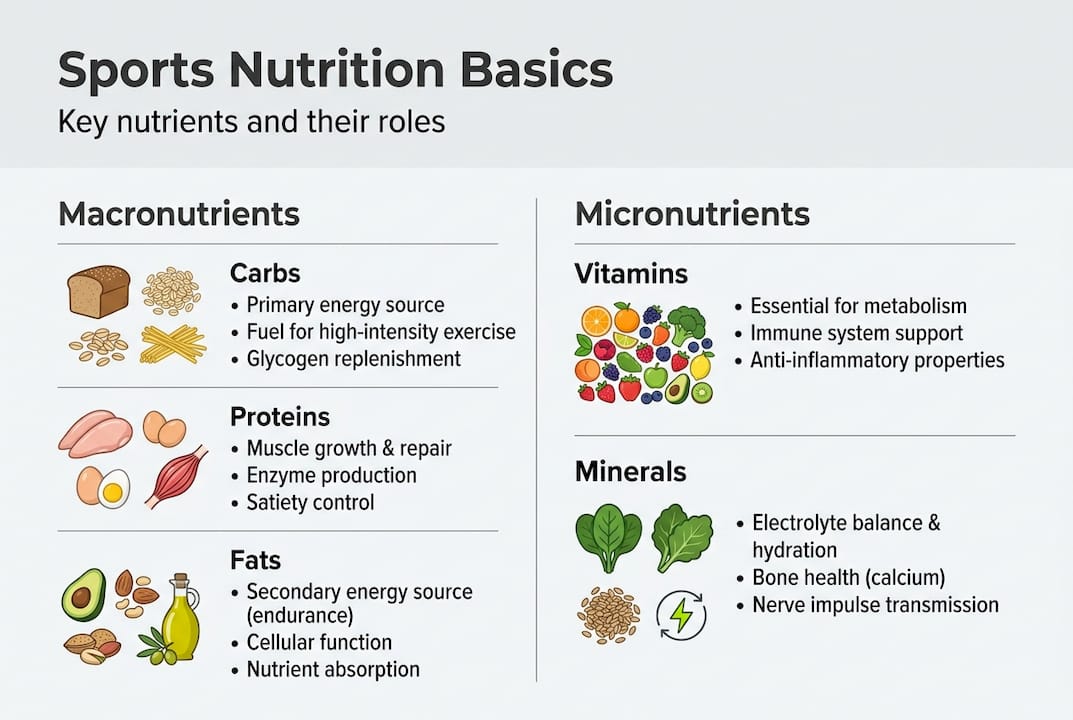
Every sports nutrition conversation starts with nutrients, yet the terminology trips people up constantly. Macronutrients include carbohydrates, proteins, and fats; micronutrients are the vitamins and minerals your body needs in smaller amounts but cannot function without. Understanding both categories is the foundation of any solid nutrition plan.
| Nutrient | Primary function | Athlete sources |
|---|---|---|
| Carbohydrates | Energy supply, glycogen storage | Oats, rice, fruit, sports drinks |
| Proteins | Muscle repair and growth | Whey, chicken, eggs, legumes |
| Fats | Hormone production, joint health | Salmon, avocado, nuts, olive oil |
| Vitamins | Metabolic reactions, immunity | Leafy greens, citrus, dairy |
| Minerals | Bone strength, nerve function | Spinach, seeds, red meat |
Two terms that often confuse athletes are BMR (Basal Metabolic Rate) and TDEE (Total Daily Energy Expenditure). BMR is the number of calories your body burns at complete rest to keep you alive. TDEE adds your activity level on top of that. If you’re eating to your BMR but training hard, you’re almost certainly under-fuelling.
Amino acids are the building blocks of protein. There are 20 in total: 9 are essential (your body cannot make them, so you must eat them) and 11 are non-essential (your body can produce them). For muscle building, the essential amino acids matter most, particularly leucine, which triggers muscle protein synthesis (MPS). You can read more about micronutrition essentials to see how vitamins and minerals fit into this picture.
Bioavailability refers to how much of a nutrient your body actually absorbs and uses. Whey protein, for instance, has higher bioavailability than many plant proteins, which is why it remains popular in sports nutrition. Check the sports nutrition basics guide for a broader overview of how these terms connect in practice.
Common high-quality sources in athlete diets include:
- Whey protein (fast-digesting, high leucine content)
- Oats (slow-release carbohydrates, rich in fibre)
- Salmon (omega-3 fats, complete protein)
- Leafy greens (iron, calcium, folate)
- Eggs (complete amino acid profile, healthy fats)
Pro Tip: Bioavailability varies significantly between supplement forms. A cheaper supplement with low bioavailability may deliver less actual nutrition than a pricier, better-absorbed alternative. Always check the form of the ingredient, not just the dose on the label.
Key performance markers and physiological terms
With nutrient definitions locked in, let’s look at the markers and physiological terms that bring sports nutrition science to life. These are the numbers and concepts that separate athletes who guess from those who plan.

BMR, TDEE, glycaemic index, glycogen, leucine threshold, MPS and MPB are the core performance concepts every serious athlete should understand. Here’s a quick reference:
| Term | Definition | Why it matters |
|---|---|---|
| BMR | Calories burned at rest | Sets your calorie floor |
| TDEE | Total daily calorie need | Guides intake for goals |
| Glycaemic index (GI) | Speed of blood sugar rise from carbs | Affects energy timing |
| Glycogen | Stored carbohydrate in muscle and liver | Primary fuel for intense effort |
| Leucine threshold | Minimum leucine to trigger MPS | Guides protein dose per meal |
| MPS | Muscle protein synthesis | Muscle building process |
| MPB | Muscle protein breakdown | Muscle loss process |
BMR varies considerably based on age, sex, and body weight. A 25-year-old male athlete may have a BMR 20 to 30% higher than a sedentary person of the same age, which directly changes how much food and supplementation he needs. Ignoring this leads to chronic under or over-eating.
Glycogen is particularly important for high-intensity athletes. Your muscles store roughly 300 to 500 grams of glycogen, enough for around 90 minutes of hard effort. When glycogen runs low, performance drops sharply. This is why carbohydrate timing around training sessions is not optional for serious athletes. Explore sport nutrition benchmarks for specific intake targets.
The leucine threshold concept is particularly useful. Research suggests you need roughly 2 to 3 grams of leucine per meal to maximally stimulate MPS. This is why spreading protein across 3 to 4 meals per day tends to outperform eating one large protein meal.
Electrolytes are minerals that carry an electrical charge and are critical for muscle contraction, nerve signalling, and hydration. Sodium, potassium, magnesium, and calcium are the key ones. Losing electrolytes through sweat without replacing them causes cramps, fatigue, and reduced output. Learn more about electrolytes and hydration to understand how to manage them effectively.
Key markers to monitor in your own nutrition planning:
- Track TDEE to set accurate calorie targets
- Monitor glycogen depletion signs (early fatigue, poor focus)
- Aim for leucine threshold at each protein meal
- Replace electrolytes after sessions lasting over 60 minutes
Frameworks and strategies: from periodisation to the 4Ps
Understanding individual terms is useful, but they have more value when applied through proven strategies. Two of the most practical frameworks in sports nutrition are periodisation and the 4Ps model.
Periodisation means structuring your nutrition to match different phases of training. It’s not just for elite athletes. Even recreational gym-goers benefit from adjusting carbohydrate and calorie intake based on whether they’re in a heavy training block, a deload week, or a competition period.
| Approach | Traditional carb loading | Modern carb loading |
|---|---|---|
| Duration | 3 to 6 days depletion phase | 1 to 2 days high-carb intake |
| Depletion required | Yes | No |
| Practical difficulty | High | Low |
| Performance benefit | Moderate | Comparable or better |
| Athlete suitability | Endurance specialists | Most sport types |
Modern carbohydrate loading protocols show that a prolonged depletion phase is no longer necessary. A 24 to 48 hour high-carb window before competition achieves similar glycogen saturation with far less discomfort.
The 4Ps framework is a practical model for structuring athlete nutrition:
- Personalise: Tailor intake to your body weight, sport, and goals
- Periodise: Adjust nutrition across training phases
- Prefuel: Eat strategically before training to maximise output
- Prepare: Plan recovery nutrition immediately post-session
For recovery, a 3:1 or 4:1 carbohydrate to protein ratio post-exercise is a widely used benchmark. This combination replenishes glycogen while supporting MPS. Explore post-workout nutrition for specific meal and supplement strategies. You can also look at boosting performance with nutrition for a wider view of timing strategies.
Pro Tip: Carb loading doesn’t require a depletion phase. Modern protocols simply involve increasing carbohydrate intake to 8 to 12 grams per kilogram of body weight in the 24 to 48 hours before competition. Simpler, more comfortable, and just as effective.
Interpreting supplement terms, risks, and best practice
Practical frameworks help you plan, but supplement safety and terminology deserve special attention. The supplement market is largely unregulated, which means label literacy is a genuine skill worth building.
Here are the key terms you’ll encounter on supplement labels:
- Third-party tested: An independent organisation has verified the product’s contents
- Proprietary blend: Ingredients are listed but individual doses are hidden behind a combined weight. This limits your ability to assess effectiveness
- Standardised extract: A plant or compound has been processed to contain a consistent percentage of the active ingredient
- Serving size: The dose the manufacturer recommends, which may not align with research-backed doses
- Informed Sport certified: A specific quality mark indicating the product has been batch tested for banned substances
The ISSN recommends that athletes prioritise batch-tested supplements to reduce the risk of inadvertent doping from undeclared substances.
Contamination is a real risk, particularly for competitive athletes subject to anti-doping rules. Risks from undeclared substances are well documented, and even trace amounts of banned compounds can result in a failed test. This is not a theoretical concern.
The supplements with the strongest evidence base, according to empirical benchmarks, include:
- Creatine: Improves strength, power, and high-intensity performance
- Caffeine: Enhances endurance, focus, and reaction time
- Protein supplements: Support MPS when whole food intake falls short
- Carbohydrate supplements: Fuel endurance events and speed recovery
For a deeper look at safe use, visit safe supplement use and supplementation for athletes.
Pro Tip: Always look for the Informed Sport logo or an equivalent quality mark before purchasing any supplement. It’s the simplest way to verify that what’s on the label is actually in the product.
Why learning the language of sports nutrition pays off
Here’s something most fitness content won’t tell you: the athletes who make the most consistent progress are rarely the ones chasing the newest supplement. They’re the ones who understand what they’re taking and why.
Misunderstood terminology costs real money. Buying a high-dose supplement without knowing the leucine threshold means you might be doubling up unnecessarily. Confusing BMR with TDEE means your calorie targets could be completely off. These aren’t small errors.
Mastering sports nutrition basics gives you a filter. When a new product launches with bold claims, you can evaluate it against what you know. You’re not swayed by marketing language because you understand what the terms actually mean.
The real advantage is adaptability. Athletes who know their TDEE, understand glycogen dynamics, and can read a supplement label critically can adjust their approach as their training changes. That flexibility, built on knowledge rather than habit, is where the lasting gains come from.
Next steps: fuel your knowledge and performance
If you’re ready to put your new knowledge to work, here are practical next steps. Understanding the terminology is only the beginning. The real value comes from applying it through quality products that match evidence-based standards.
At MyGymSupplements.shop, you’ll find a carefully curated range of premium sports supplements covering everything from creatine and whey protein to electrolytes and pre-workouts. Every category is organised around your goals, whether that’s muscle gain, recovery, endurance, or weight management. Now that you know what to look for on a label, what bioavailability means, and why batch testing matters, you’re equipped to shop smarter and train harder.
Frequently asked questions
What are the essential macronutrients and why do they matter in sports nutrition?
Carbohydrates, proteins, and fats are the three essential macronutrients, each playing a distinct role in fuelling performance, supporting muscle repair, and maintaining hormone balance. Without adequate intake of all three, training adaptations and recovery are compromised.
How does periodisation impact sports nutrition planning?
Periodisation aligns nutrition with training phases, meaning you increase carbohydrate and calorie intake during heavy blocks and reduce them during lighter periods. This approach optimises both performance and body composition over time.
What does ‘batch tested’ mean on supplement labels?
Batch testing means an independent third party has tested a specific production batch of a supplement for banned or harmful substances. It’s the most reliable way to verify product safety, especially for competitive athletes.
How can understanding the glycaemic index (GI) benefit athletes?
The GI reflects how quickly a carbohydrate raises blood sugar, which helps athletes choose the right carb source before, during, or after training. High-GI carbs are useful for rapid glycogen replenishment post-exercise, while low-GI options sustain energy during longer sessions.
Recommended
- Guide to Sports Nutrition Basics for Optimal Results – MyGymSupplements
- Guide to Sports Nutrition Basics for Optimal Results – MyGymSupplements
- How to Fuel Athletic Performance for Peak Results – MyGymSupplements
- How to boost athletic performance with nutrition
- Sauna Before or After Workout: Science-Backed Protocols – Marterra Elements

0 comments