

Competitive athletes constantly push their bodies to new limits, yet many encounter frustrating performance plateaus and sluggish recovery times. These obstacles can derail training progress and competitive outcomes. Creatine supplementation offers a scientifically backed solution to enhance power output, accelerate strength gains, and improve recovery when implemented correctly. This guide provides evidence-based strategies to maximise creatine’s benefits for athletic performance in 2026.
Table of Contents
- Understanding Creatine And Its Benefits For Athletes
- Preparing For Creatine Supplementation: Dosage, Timing And Safety
- Step-By-Step Guide To Creatine Supplementation For Athletes
- Monitoring Results And Troubleshooting Common Issues
- Discover Effective Creatine Supplements For Athletes
- Frequently Asked Questions
Key takeaways
| Point | Details |
|---|---|
| Performance enhancement | Creatine significantly boosts muscle strength, power output, and high-intensity exercise capacity for competitive athletes. |
| Loading and maintenance phases | A loading phase rapidly saturates muscles within days, whilst maintenance dosing sustains elevated creatine levels long-term. |
| Safety profile | Creatine is safe for healthy athletes when proper dose guidelines are followed, with no adverse effects on kidney function. |
| Timing flexibility | Consistent daily intake matters most, though pairing with carbohydrates or protein may slightly enhance absorption. |
Understanding creatine and its benefits for athletes
Creatine monohydrate stands as the gold standard supplement for athletes seeking tangible improvements in strength, power, and recovery. This naturally occurring compound plays a crucial role in your body’s energy production system, particularly during explosive movements and high-intensity efforts. When you supplement with creatine, you increase muscle phosphocreatine stores, which directly enhances your anaerobic capacity for sprints, heavy lifts, and repeated bouts of intense activity.
Research consistently demonstrates that creatine supplementation enhances muscle strength and power across various athletic populations. Beyond immediate performance gains, creatine accelerates muscle glycogen resynthesis following exercise, helping you recover faster between training sessions. This recovery enhancement proves particularly valuable during competition periods or intense training blocks when you need to perform at peak capacity repeatedly.
You can optimise creatine uptake by consuming it alongside carbohydrates or protein, though this strategy remains optional rather than essential. Studies show that creatine is absorbed more efficiently with carbs or protein, but the difference in practical outcomes tends to be modest for most athletes.
Common misconceptions about creatine safety persist despite decades of research:
- Creatine does not cause kidney damage in healthy individuals
- Water retention is minimal and intracellular, not subcutaneous bloating
- Creatine does not require cycling for effectiveness or safety
- Hair loss claims lack scientific support in human studies
“Creatine monohydrate remains the most extensively researched and proven supplement for athletic performance enhancement, with a safety profile that surpasses most other ergogenic aids.”
For athletes serious about maximising results, understanding proper implementation becomes crucial. The creatine usage guide offers detailed insights into tailoring supplementation to your specific training goals.
Preparing for creatine supplementation: dosage, timing and safety
Proper preparation ensures you extract maximum benefit from creatine whilst avoiding common pitfalls. The loading phase represents your first step, rapidly saturating muscle creatine stores by 20 to 40% within just one week. This accelerated approach typically involves consuming approximately 20 grams daily, split into four separate doses of 5 grams each, for 5 to 7 consecutive days.
Following the loading phase, you transition to maintenance dosing. Research confirms that loading is approximately 20g daily for 5 to 7 days, with maintenance at 3 to 5g daily. This lower maintenance dose sustains elevated creatine levels and preserves the performance benefits you’ve gained.
Essential dosage and timing considerations:
- Creatine monohydrate offers the best efficacy and value compared to alternative forms
- Splitting loading doses throughout the day may reduce gastrointestinal discomfort
- Timing flexibility allows you to take creatine whenever convenient, though post-workout with a meal offers theoretical advantages
- Consistency matters more than precise timing for long-term results
Safety considerations deserve attention despite creatine’s excellent track record. Studies demonstrate that no adverse effects occur on renal function in healthy individuals taking recommended doses. However, you should avoid creatine supplementation if you have pre-existing kidney disease, as research in compromised populations remains limited. Pregnant women should also abstain due to insufficient safety data in this population.

Some athletes experience mild gastrointestinal discomfort during loading phases, particularly when consuming large single doses. Spreading your intake across multiple smaller doses typically resolves this issue. If you discontinue supplementation, muscle creatine levels gradually return to baseline over approximately 4 to 6 weeks, with no negative rebound effects.
Pro Tip: Athletes competing in weight-class sports may prefer skipping the loading phase and using maintenance doses from day one. This approach takes 3 to 4 weeks to fully saturate muscles but avoids the temporary water weight gain associated with rapid loading.
Understanding proper cycling can further optimise your supplementation strategy. The guide on how to cycle creatine addresses whether cycling provides additional benefits for athletic performance.
Step-by-step guide to creatine supplementation for athletes
Implementing creatine correctly transforms theoretical knowledge into measurable performance gains. Follow this systematic approach to maximise strength, power, and recovery outcomes.
1. Begin with the loading phase
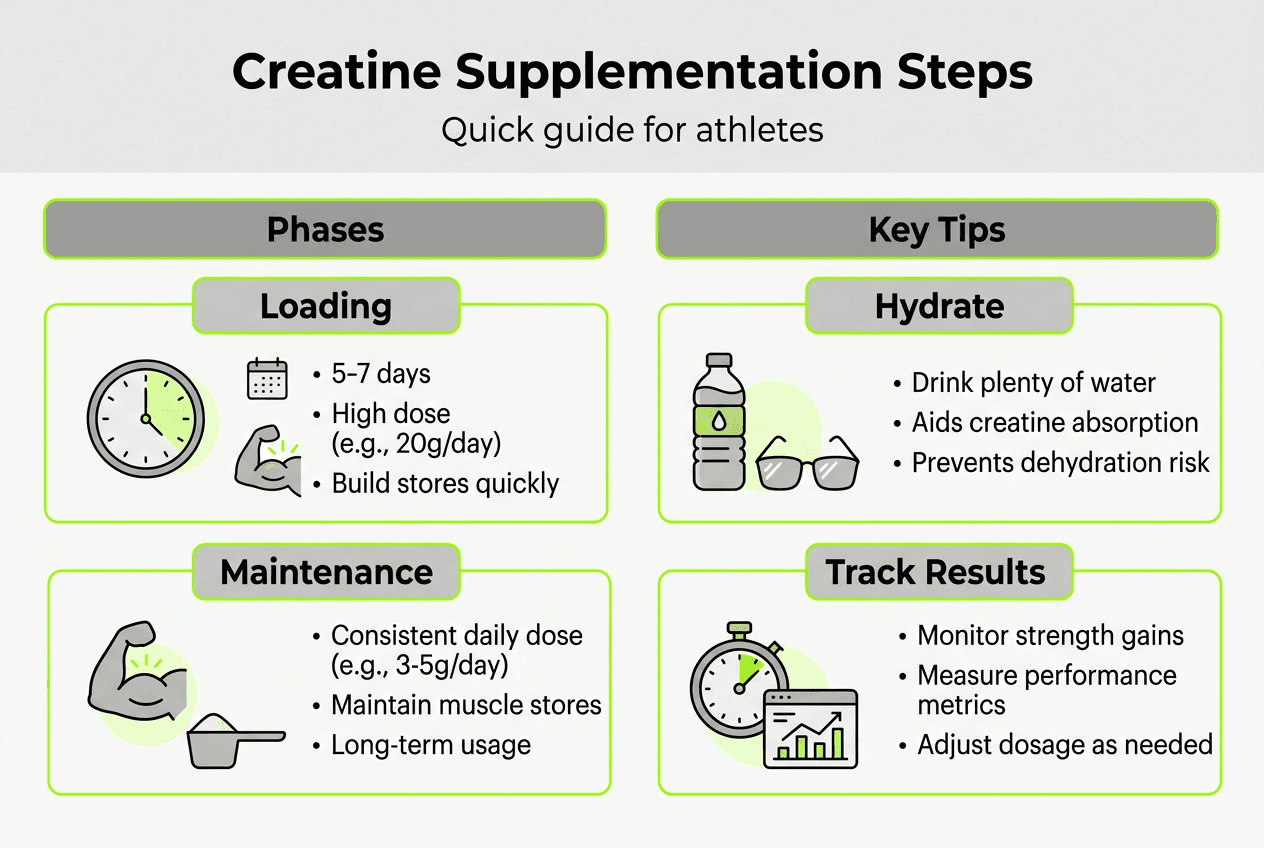
Consume approximately 20 grams of creatine monohydrate daily, divided into four 5-gram doses spread throughout the day. Continue this protocol for 5 to 7 consecutive days. Take each dose with at least 250ml of water to ensure proper dissolution and absorption. Spacing doses every 3 to 4 hours helps minimise any digestive discomfort whilst optimising muscle uptake.
2. Transition to maintenance dosing
After completing the loading phase, reduce your intake to 3 to 5 grams daily. This maintenance dose sustains elevated muscle creatine stores indefinitely. Most athletes find 5 grams daily provides optimal results, particularly during intense training periods or competition seasons.
3. Establish consistent timing
Take your creatine at the same time each day to build a sustainable habit. Whilst timing flexibility exists, consuming creatine post-workout with a meal containing protein and carbohydrates may marginally enhance uptake. However, consistency trumps timing precision for long-term success.
4. Maintain proper hydration
Drink adequate water throughout the day, aiming for at least 2 to 3 litres for most athletes. Despite persistent myths, creatine does not cause dehydration, but proper hydration supports overall performance and helps dissolve the supplement effectively.
5. Track your progress systematically
Monitor strength metrics, power output, and recovery markers from the first week onwards. Research shows that proper loading protocols often produce strength gains within 3 to 5 days. Document changes in your one-rep max lifts, sprint times, or high-intensity interval performance to verify effectiveness.
Pro Tip: Athletes who travel frequently can simplify supplementation by pre-measuring daily doses into small containers or using single-serve packets. This ensures consistent intake even when your routine changes.
Creatine supplementation timeline and expected outcomes:
| Phase | Duration | Daily Dose | Expected Results |
|---|---|---|---|
| Loading | 5-7 days | 20g (4×5g) | 20-40% increase in muscle creatine stores |
| Early maintenance | Weeks 2-4 | 3-5g | Sustained strength gains, improved power output |
| Long-term | Ongoing | 3-5g | Continued performance enhancement, faster recovery |
For a comprehensive breakdown of implementation strategies, refer to the step by step guide to creatine usage that addresses sport-specific applications.
Monitoring results and troubleshooting common issues
Evaluating your response to creatine supplementation ensures you’re extracting maximum value from your investment. Most athletes notice tangible improvements within the first week when following proper loading protocols. Expect strength increases of 5 to 15% in compound lifts, enhanced power output during explosive movements, and reduced fatigue during high-intensity intervals.
Recovery improvements often manifest as reduced muscle soreness and faster restoration of performance between training sessions. Research confirms that creatine enhances muscle recovery and reduces inflammation after exercise, making it particularly valuable during competition periods or heavy training blocks.
Common issues and practical solutions:
- Gastrointestinal discomfort: Divide your loading dose into smaller portions taken with meals. Mixing creatine thoroughly in warm liquid improves dissolution and reduces stomach upset.
- Lack of noticeable results: Ensure you’re taking the full maintenance dose daily without skipping days. Some athletes require 4 to 6 weeks to experience full benefits, particularly non-responders with naturally high muscle creatine levels.
- Concerns about water retention: Creatine causes intracellular water retention in muscle tissue, which contributes to the performance benefits. This is not subcutaneous bloating and typically adds only 0.5 to 1kg of scale weight.
- Inconsistent dosing: Set phone reminders or pair supplementation with an existing daily habit like breakfast or post-workout meals to ensure consistency.
If you experience no improvement after several weeks of consistent supplementation at proper doses, consider consulting a sports nutritionist or exercise physiologist. Approximately 20 to 30% of individuals are “non-responders” who naturally maintain high muscle creatine levels and gain minimal benefit from supplementation. Dietary assessment and muscle biopsy can determine responder status, though these measures are rarely necessary for recreational athletes.
For athletes seeking to optimise results further, exploring quality supplement options becomes essential. Reviews like maximize performance per4m creatine provide insights into product selection and formulation quality.
Discover effective creatine supplements for athletes
Transforming knowledge into results requires access to quality supplements backed by research and manufacturing standards. MyGymSupplements shop offers a curated selection of high-quality creatine monohydrate products specifically chosen for competitive athletes and strength trainers. Each product undergoes rigorous quality assessment to ensure purity, potency, and effective dosing.
Whether you’re beginning your supplementation journey or optimising an existing protocol, detailed resources on creatine usage guide and how to cycle creatine help you tailor strategies to your specific training goals. Start maximising your performance potential with trusted products and expert guidance today.
Frequently asked questions
What dosage of creatine should athletes take?
Begin with a loading phase of approximately 20 grams daily, split into four 5-gram doses, for 5 to 7 days. Follow with a maintenance dose of 3 to 5 grams daily to sustain elevated muscle creatine levels. Consistency in daily intake matters more than precise timing for optimal results.
Is creatine supplementation safe for all athletes?
Creatine is safe for healthy athletes with normal kidney function, supported by decades of research showing no adverse effects. However, individuals with pre-existing kidney disease should avoid supplementation due to limited research in compromised populations. Pregnant women should also abstain due to insufficient safety data.
Should creatine be taken with food or on an empty stomach?
Taking creatine with carbohydrates or protein may slightly improve absorption, but this enhancement is optional rather than essential. Consuming creatine with meals often reduces gastrointestinal discomfort, particularly during loading phases. The most important factor is consistent daily intake regardless of timing.
How soon will I notice results from creatine supplementation?
Most athletes experience noticeable strength gains within 3 to 5 days when following proper loading protocols. Power output improvements and enhanced high-intensity performance typically manifest within the first week. Continued benefits develop progressively over subsequent weeks with consistent maintenance dosing.
Recommended
- Step-by-Step Guide to Creatine Usage for Athletes – MyGymSupplements
- Step-by-Step Guide to Creatine Usage for Athletes – MyGymSupplements
- Discover 10X Athletic CRE: Ultimate Creatine for Athletes – MyGymSupplements
- How to Start Creatine Supplementation for Muscle Gain – MyGymSupplements
- Creatine Gummies vs Powder: Ultimate Comparison Guide 4 Strength
- Plant Based Diet for Athletes – Unlocking Peak Performance – naturessoulshop

0 comments