

TL;DR:
- Creatine enhances short-duration high-intensity efforts by increasing rapid ATP resynthesis.
- It supports muscle growth, strength gains, faster recovery, and reduces exercise-induced inflammation.
- Safe for healthy athletes, most underuse its recovery and long-term performance benefits.
Creatine has a reputation problem. Many athletes still think of it as a supplement purely for bodybuilders chasing size, but that picture is badly out of date. Whether you sprint, lift, cycle, or compete in team sports, creatine works at a cellular level to fuel explosive efforts, protect muscle tissue, and speed up recovery between sessions. The evidence behind it is some of the strongest in sports nutrition. This guide cuts through the noise and gives you a clear, science-backed look at what creatine actually does, who benefits most, and how to use it without second-guessing yourself.
Table of Contents
- How creatine works in the athlete’s body
- Strength, muscle gain, and power: the proven benefits
- Faster recovery and reduced muscle damage
- Is creatine safe for athletes?
- Why most athletes underuse creatine’s true potential
- Ready to benefit from creatine? Start your journey
- Frequently asked questions
Key Takeaways
| Point | Details |
|---|---|
| Enhances rapid performance | Creatine boosts short-term power and strength by replenishing energy stores in muscles. |
| Accelerates recovery | Supplementation supports faster muscle repair and reduces post-exercise soreness in athletes. |
| Proven safe for most | Studies show creatine is safe for healthy athletes when used at recommended dosages. |
| Greater gains for some | Vegetarians, untrained athletes, and those with lower baseline levels typically experience more pronounced results. |
| Simple to integrate | Combining creatine with proper training routines and nutrition is straightforward and highly effective. |
How creatine works in the athlete’s body
To understand why creatine matters, you need to understand one thing: your muscles run on ATP (adenosine triphosphate). ATP is the currency your cells spend during every contraction, every sprint, every heavy pull. The problem is your muscles only store enough ATP for about two seconds of maximal effort. After that, they need to resynthesise it fast.
This is where creatine steps in. It is stored in muscle as phosphocreatine (PCr), and PCr donates a phosphate group to ADP to rapidly regenerate ATP. Creatine increases phosphocreatine in muscle, enabling rapid ATP resynthesis during intense exercise. Supplementing with creatine raises your PCr stores by 20 to 40%, which means your muscles can sustain maximal output for 10 to 15 seconds rather than burning out in two.
That window matters enormously. It covers the duration of a heavy squat set, a 100-metre sprint, a boxing combination, or a rugby tackle sequence. Explore creatine use strategies to see how timing and dosing interact with these energy demands.
Beyond raw energy, creatine also triggers cell volumisation. When muscle cells draw in water alongside creatine, they swell slightly, which activates anabolic signalling pathways. This is not just cosmetic. It primes the muscle environment for growth and repair even before you add progressive overload.
Who benefits most from creatine supplementation?
- Athletes with low baseline creatine stores, particularly vegetarians and vegans
- Untrained or early-stage athletes who see the steepest initial adaptations
- Those performing repeated high-intensity efforts with short rest periods
- Athletes returning from injury or detraining phases
| Energy system | Duration | Creatine relevance |
|---|---|---|
| Phosphocreatine (PCr) | 0 to 10 seconds | Very high |
| Glycolytic | 10 to 90 seconds | Moderate |
| Aerobic | 90 seconds and beyond | Lower but still present |
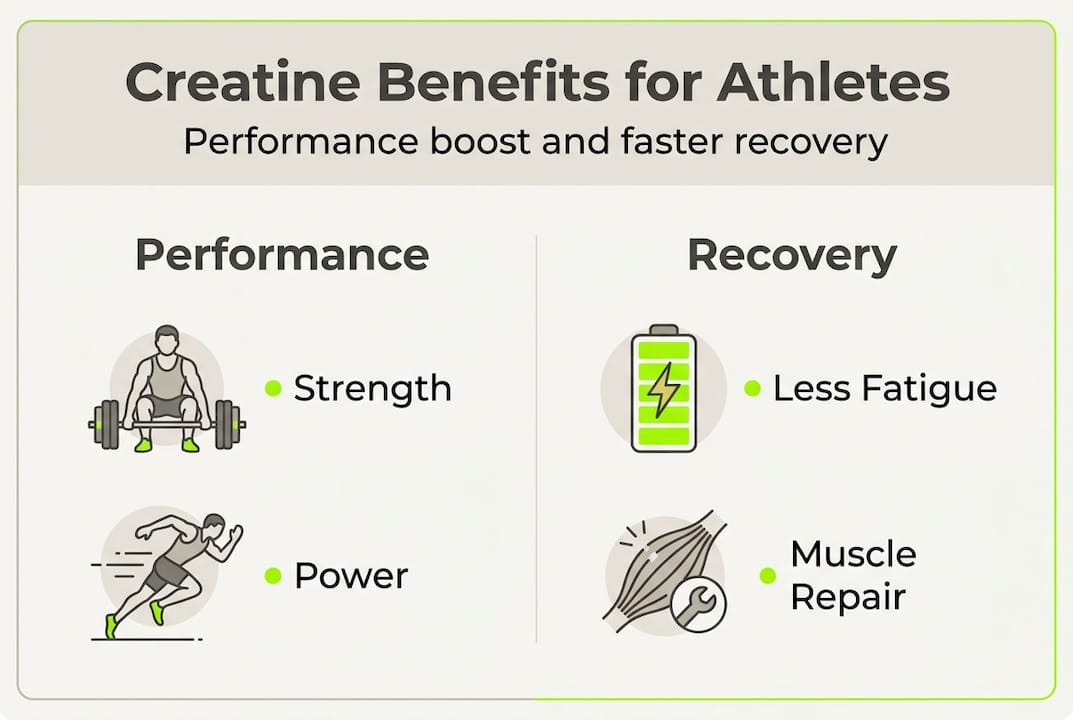
The short-duration, high-intensity window is where creatine delivers its clearest advantage. But as you will see in the recovery section, its benefits extend well beyond the first few seconds of effort.
Strength, muscle gain, and power: the proven benefits
Understanding how creatine fuels muscle cells leads us to the results athletes actually see. The research here is unusually consistent for a supplement category often plagued by weak or conflicting data.
Meta-analyses link creatine plus resistance training to significant gains in strength, lean mass, and power. Across studies, athletes using creatine alongside resistance training show:
- Increases in one-rep max strength of roughly 5 to 15% compared to placebo groups
- Lean mass gains averaging around 1.37 to 1.39 kg over training periods of 4 to 12 weeks
- Improvements in peak power output during sprint and jump tests
- Greater training volume capacity, meaning more reps completed per session
The benefits are not uniform across all athletes. Untrained individuals and those with lower baseline creatine levels (such as vegetarians) tend to see the most dramatic early improvements. Trained athletes still benefit, but the effect size is somewhat smaller because they have already adapted to higher training loads.
| Outcome measure | Untrained athletes | Trained athletes |
|---|---|---|
| Fat-free mass increase | Up to 1.39 kg | Moderate (0.5 to 1 kg) |
| Strength (SMD) | High | Moderate |
| Power output | Significant | Meaningful |
| Recovery speed | High | Moderate to high |
Review creatine cycling tips to understand how periodising your intake can help maintain sensitivity and results over longer training blocks. You can also see how MyProtein creatine results translate in real-world training contexts.
Beyond the headline numbers, creatine also appears to reduce exercise-induced inflammation and may have anti-catabolic properties, meaning it helps protect muscle tissue from breakdown during hard training phases. For athletes managing heavy competition schedules, that is a meaningful edge.
“Creatine is one of the few supplements where the performance data is robust enough to recommend confidently across multiple sport types and training levels.”
Faster recovery and reduced muscle damage
Beyond pure performance, recovery is where creatine offers another strong advantage. Most athletes focus on what creatine does during a session. Fewer realise what it does in the hours and days after.

Creatine supplementation attenuates muscle damage, quickens phosphocreatine resynthesis, and lowers specific inflammatory markers including TNF-α, CRP, and IL-6. These are the same markers that rise sharply after intense training and competition, and their elevation is directly linked to delayed onset muscle soreness (DOMS) and impaired function in the days that follow.
Recent clinical data shows that short-term loading improves HRV, reduces perceived strain, and speeds up recovery markers in under a week. Heart rate variability (HRV) is one of the most reliable indicators of readiness to train, and improving it means you can return to high-quality sessions sooner.
Practical recovery benefits you can expect:
- Reduced DOMS severity after eccentric-heavy sessions such as squats or downhill running
- Faster restoration of muscle function between competition days
- Better glycogen reloading when creatine is taken with carbohydrates post-training
- Lower perceived exertion during back-to-back training days
For athletes on creatine loading routines, the recovery benefits often appear within the first week, which is particularly useful before a competition block or during pre-season.
Pro Tip: Pair your post-training creatine dose with a carbohydrate source. Insulin release from carbohydrates enhances creatine uptake into muscle cells, making each dose more effective and accelerating the recovery process.
The anti-inflammatory effect is not dramatic enough to replace rest or nutrition, but it creates a measurable buffer that allows harder training with less accumulated damage over time. For athletes training six or seven days per week, that buffer compounds significantly.
Is creatine safe for athletes?
Evidence of effectiveness is clear, but what about the safety concerns that persist among athletes? Kidney damage. Cramps. Dehydration. These concerns have circulated for decades, and they are almost entirely unsupported by the research.
Extensive research finds no increased risk of dehydration, cramps, or kidney issues in healthy athletes using creatine appropriately. Studies spanning multiple years, including trials with professional athletes and military personnel, consistently show no adverse renal outcomes at standard doses of 3 to 5 grams per day.
What the evidence actually shows about creatine safety:
- No link to kidney injury in healthy adults at recommended doses
- No increased risk of muscle cramps or heat-related illness
- No evidence of liver damage or hormonal disruption
- No association with dehydration, even in hot and humid training conditions
That said, athletes with pre-existing kidney conditions should consult a doctor before starting creatine. The supplement increases creatinine output, which is a normal metabolic byproduct, but it can skew kidney function test results and complicate clinical monitoring.
Gastrointestinal symptoms and weight gain from increased muscle and water content are the most common minor effects, particularly at higher or rapidly loaded doses. If you experience stomach discomfort during a loading phase, splitting your daily dose into three or four smaller servings across the day usually resolves it.
Pro Tip: If you are new to creatine, consider skipping the loading phase entirely. Research shows that taking 3 to 5 grams daily without loading reaches the same muscle saturation point within three to four weeks, with far fewer digestive side effects.
For athletes curious about specific product options, the nutrition creatine tips section covers practical guidance on formats and dosing approaches that suit different training schedules.
Why most athletes underuse creatine’s true potential
Here is the honest reality: most athletes who take creatine are leaving a significant portion of its benefit on the table. They load up, see some strength gains, and treat it as a muscle-building tool. Full stop. But creatine’s value as a recovery aid, an anti-inflammatory buffer, and an adaptation accelerator is consistently overlooked.
The pro-strength and recovery data is consistent and robust, with no valid evidence for chronic inflammation or cancer risks in humans, yet many athletes still cycle off creatine unnecessarily out of unfounded fear. Long-term use at maintenance doses is both safe and more effective than short bursts.
The athletes who get the most from creatine are those who treat it as a year-round performance tool rather than a pre-competition trick. Small, consistent daily doses. Timed with carbohydrates post-training. Paired with adequate hydration. These creatine strategies athletes miss are simple, but they make a genuine difference across a full season of training.
Misinformation persists because legacy myths are stickier than modern data. But the science is clear, and athletes who act on it gain a real, compounding advantage.
Ready to benefit from creatine? Start your journey
Whether you are preparing for your next competition or simply want to recover smarter between sessions, having the right creatine product matters as much as the protocol you follow. Quality, purity, and format all affect how well your body absorbs and uses what you take. At MyGymSupplements.shop, you will find a curated range of trusted creatine supplements from leading brands, alongside expert guidance to help you choose the right option for your goals and training style. From monohydrate to more specialised formats, the range is built for athletes who want results backed by evidence, not marketing claims.
Frequently asked questions
How quickly can athletes notice results from creatine supplementation?
Many athletes see improvements in strength or short-term performance within 5 to 7 days of starting creatine with a loading protocol. Short-term loading enhances reps, velocity, and recovery markers in under a week.
Is creatine safe for long-term use by athletes?
Research shows no increased risk of kidney problems, dehydration, or muscle cramps with correct creatine use in healthy athletes. No adverse events or increased risk for kidney issues have been found in long-term studies.
Do vegetarians or vegans benefit more from creatine?
Vegetarians and vegans often see greater increases in strength and muscle due to lower baseline creatine levels from their diet. Greater gains in untrained or low-baseline individuals include fat-free mass increases of up to 1.39 kg.
Can creatine cause water retention or weight gain?
Yes, initial weight gain is common due to both muscle growth and water storage in muscle cells, especially with rapid loading. Weight gain from increased muscle and water content is a well-documented minor effect during loading phases.
Is creatine beneficial for endurance or only for power sports?
While creatine is most effective for short, intense efforts, it may also reduce fatigue and aid recovery in endurance athletes. Creatine supports glycogen reloading and reduces muscle soreness, benefiting some endurance events.

0 comments