

Choosing the right supplements can be confusing for British athletes, especially when more than 60 percent of popular sports products contain proprietary blends. Without clear ingredient details, bodybuilders risk missing out on optimal workout results and precise nutrition planning. This article breaks down what proprietary blends mean for your fitness journey, helping you distinguish between safe, effective formulas and those that leave too much to guesswork.
Table of Contents
- Proprietary Blends In Supplements Explained
- How Proprietary Blends Are Formulated
- Legal Rules For Supplement Labels In The UK
- Potential Benefits And Key Risks For Users
- Comparing Proprietary Blends With Transparent Formulas
Key Takeaways
| Point | Details |
|---|---|
| Understanding Proprietary Blends | Proprietary blends conceal individual ingredient quantities, making it challenging for athletes to assess the effectiveness and potency of supplements. |
| Regulatory Compliance | UK supplement labels must provide complete ingredient lists and dosage information to ensure consumer safety and informed choices. |
| Transparency vs. Secrecy | Transparent formulas enhance consumer confidence by disclosing ingredient amounts, whereas proprietary blends prioritise brand protection over consumer insight. |
| Risk Awareness | Athletes should prioritise reputable supplements with clear testing practices to mitigate health and competitive risks associated with proprietary blends. |
Proprietary blends in supplements explained
A proprietary blend represents a supplement manufacturer’s unique formula where specific ingredient quantities remain undisclosed. When examining supplement ingredient details, athletes encounter a complex landscape of potential benefits and transparency challenges.
Proprietary blends typically list total blend weight without revealing individual ingredient proportions. This approach allows manufacturers to protect their unique formulation while potentially obscuring critical details about ingredient concentrations. Athletes seeking precise nutritional strategies may find these blends problematic, as understanding exact dosages becomes challenging.
The primary implications for UK athletes include potential uncertainty around supplement effectiveness and individual ingredient potency. Without transparent labelling, consumers cannot definitively assess whether the blend contains therapeutically meaningful amounts of each component. Some proprietary blends might include ingredients in such minimal quantities that their physiological impact becomes negligible.
Pro tip: Always request detailed ingredient breakdowns from supplement manufacturers and compare multiple product labels to make informed nutritional choices.
How proprietary blends are formulated
Proprietary blend formulation represents a sophisticated process of custom nutritional product development that balances scientific innovation, market demands, and brand protection. Manufacturers carefully select ingredients to create unique nutritional solutions that differentiate themselves in a competitive supplement marketplace.

The formulation process involves intricate strategic considerations beyond simple ingredient combination. Supplement manufacturers protect their trade secrets by maintaining confidential ingredient proportions while ensuring regulatory compliance. This approach allows brands to develop distinctive products that cannot be easily replicated by competitors, preserving their intellectual property and market positioning.
Advanced formulation strategies consider multiple factors including ingredient synergy, bioavailability, potential interaction effects, and targeted performance outcomes. Sports nutrition blends, particularly for UK athletes, often focus on optimising ingredient ratios to enhance muscular performance, recovery, and overall physiological efficiency. Manufacturers invest significant research and development resources to create blends that deliver measurable nutritional benefits while maintaining commercial confidentiality.
Pro tip: Request independent laboratory testing reports to verify the actual composition and effectiveness of proprietary supplement blends before making purchasing decisions.
Legal rules for supplement labels in the UK
In the United Kingdom, supplement labelling requires strict compliance with comprehensive regulatory standards designed to protect consumer health and ensure transparency. These regulations mandate detailed information disclosure, enabling athletes and consumers to make informed nutritional choices about the products they purchase.
The legal framework governing supplement labels includes specific requirements for content and presentation. UK supplement labels must comprehensively display critical information such as the complete ingredient list, precise active ingredient quantities per daily dose, clear usage instructions, and prominent allergen warnings. Manufacturers must also include their business operator details and adhere to guidelines established by the Food Standards Agency.
Key legal obligations for supplement manufacturers involve ensuring accurate, unambiguous labelling that provides consumers with transparent insights into product composition. This includes highlighting potential allergens, specifying recommended daily intake, and including explicit warnings about not exceeding suggested dosages. The regulations aim to prevent misleading claims and protect consumer health by mandating clear, factual product information that allows individuals to understand exactly what they are consuming.
Below is a summary of UK supplement label requirements and their significance:
| Requirement | Why It Matters |
|---|---|
| Complete ingredient list | Ensures consumers know content |
| Active ingredient per daily dose | Enables accurate dose assessment |
| Prominent allergen warnings | Protects individuals with allergies |
| Usage instructions | Guides safe and correct use |
| Manufacturer contact details | Provides source accountability |
| Exceeding dosage warnings | Reduces overdose risk |
Pro tip: Always cross-reference supplement labels against official UK regulatory guidelines and consult healthcare professionals when uncertain about a product’s compliance or potential interactions.
Potential benefits and key risks for users
Athletes considering supplements with proprietary blends must carefully navigate the complex landscape of potential performance enhancement and inherent health risks. While these formulations can offer targeted nutritional support, they simultaneously present significant challenges related to ingredient transparency and potential unintended consequences.
Supplement quality and contamination risks represent critical considerations for UK athletes. Proprietary blends may contain undisclosed ingredient quantities, potentially exposing users to ineffective dosages or unexpected interactions. The lack of precise ingredient information means athletes could inadvertently consume substances that compromise their performance, health, or competitive eligibility.
The potential benefits of proprietary blends include streamlined nutritional strategies, targeted performance support, and innovative ingredient combinations. However, these advantages must be carefully weighed against potential risks such as unverified ingredient efficacy, potential banned substance contamination, and the strict liability athletes face for any prohibited substances detected during testing. Professional athletes must exercise extreme caution, prioritising supplements from reputable sources with transparent testing protocols and comprehensive quality assurance.
Pro tip: Always request comprehensive batch testing reports and third-party certification for any supplement containing proprietary blends to minimise potential health and competitive risks.
Comparing proprietary blends with transparent formulas
The fundamental difference between proprietary blends and transparent formulas lies in their approach to ingredient disclosure. Supplement manufacturers employ distinct labelling strategies that significantly impact consumer understanding and product evaluation. Proprietary blends conceal individual ingredient quantities, prioritising formula protection, while transparent formulas provide comprehensive ingredient information.
Transparency in supplement labelling offers critical advantages for informed consumer decision-making. Transparent formulas enable athletes to precisely assess ingredient dosages, potential interactions, and efficacy. This approach allows individuals to verify whether supplement components meet recommended therapeutic quantities and identify potential allergens or contraindicated substances. In contrast, proprietary blends obscure these critical details, forcing consumers to rely predominantly on brand reputation and marketing claims.
The comparative landscape reveals nuanced trade-offs between formula secrecy and consumer empowerment. Proprietary blends protect manufacturers’ innovative formulations, preventing direct replication by competitors. However, this approach simultaneously limits scientific scrutiny and consumer confidence. Transparent formulas demonstrate a commitment to openness, enabling athletes and health-conscious individuals to make more educated nutritional choices by providing complete visibility into supplement composition.
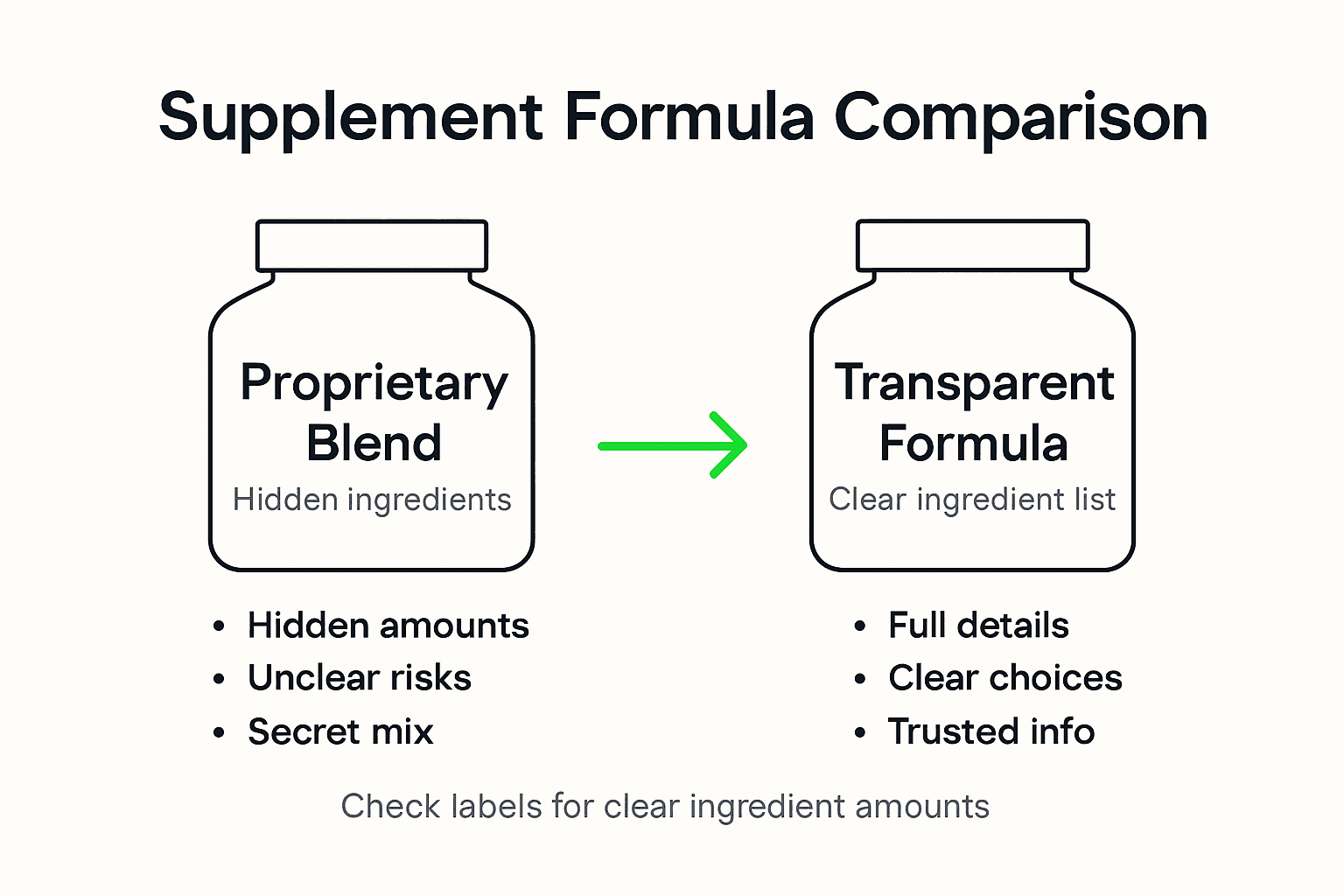
Here is a summary of the key differences between proprietary blends and transparent formulas:
| Aspect | Proprietary Blend | Transparent Formula |
|---|---|---|
| Ingredient Disclosure | Total blend weight shown | Each ingredient amount listed |
| Consumer Transparency | Limited | High |
| Brand Protection | Strong | Moderate |
| Replicability by Rivals | Difficult | Easier |
| Ability to Assess Dosages | Imprecise | Precise |
| Allergen Identification | Sometimes unclear | Always clear |
Pro tip: Prioritise supplements with fully disclosed ingredient quantities and concentrations, enabling you to make evidence-based nutritional decisions that align with your specific performance and health objectives.
Choose Transparency and Confidence in Your Supplements Today
Navigating the complex world of proprietary blends can leave UK athletes uncertain about ingredient dosages and supplement effectiveness. Are you tired of guessing what exactly you are consuming and worried about hidden substances that could impact your performance or health? At MyGymSupplements.shop, we understand that clarity and trust matter when selecting supplements tailored for muscle gain, recovery, or energy enhancement.
Explore our carefully curated selection of fitness and health supplements where transparent labelling meets quality assurance. With options across proteins, pre-workouts, amino acids, and more, you can make informed choices aligned with your goals. Don’t settle for proprietary blends that obscure ingredient details. Visit MyGymSupplements.shop now to shop confidently and take control of your nutrition with products that put transparency first.
Frequently Asked Questions
What is a proprietary blend in supplements?
A proprietary blend is a unique formulation created by supplement manufacturers that lists the total weight of specific ingredients but does not disclose the precise quantities of each component. This allows manufacturers to protect their formulas while potentially making it challenging for consumers to understand dosages.
What are the risks of taking supplements with proprietary blends?
The primary risks include uncertainty regarding the effectiveness and potency of individual ingredients. Some components may be included in minimal amounts that do not provide significant physiological benefits, and the lack of transparency can lead to potential health risks and unintentional consumption of banned substances.
How can I assess the quality of a proprietary blend?
To assess the quality of a proprietary blend, request detailed ingredient breakdowns from manufacturers, look for independent laboratory testing reports, and compare product labels to gauge the credibility and transparency of the supplement.
How do proprietary blends compare to transparent formulas?
Proprietary blends conceal individual ingredient quantities, limiting consumer transparency and assessment, while transparent formulas provide detailed information about each ingredient’s dosage, allowing for better informed decision-making regarding efficacy and safety.

0 comments