

Pushing for that extra rep in a busy United Kingdom gym means your muscles demand efficient energy, but many athletes still get tripped up by confusion about metabolism. For bodybuilders and strength enthusiasts, understanding how your body turns food into ATP—the fuel for every lift and recovery—is the real advantage. This introduction clears up the most common myths, explains what actually drives your metabolic rate, and spotlights practical steps to support stronger training output and faster adaptation. Discover what truly influences energy metabolism, and how you can take control for maximum results.
Table of Contents
- Energy Metabolism Defined And Common Myths
- Types Of Energy Pathways In The Body
- Macronutrients And ATP Production Explained
- Factors Affecting Energy Metabolism Rates
- Supporting Energy Metabolism Through Supplements
- Mistakes To Avoid With Nutrition And Recovery
Key Takeaways
| Point | Details |
|---|---|
| Metabolism is changeable | Diet and exercise significantly influence metabolic rate; focusing on muscle gain and proper nutrition can improve resting metabolism. |
| Energy pathways are interconnected | Understanding the synergy between glycolysis, the Krebs cycle, and fat oxidation is crucial for optimal training and nutrition strategies. |
| Macronutrients matter for performance | Carbohydrates are essential for high-intensity performance, while fats support endurance; balance all three for effective energy utilisation. |
| Avoid restrictive diets | Sustainable eating habits with whole foods are essential for long-term performance; extreme diets can hinder recovery and adaptation. |
Energy metabolism defined and common myths
Let’s start with what energy metabolism actually is. Metabolism encompasses all the chemical reactions inside your cells that use or release energy to keep you alive. You’re burning calories right now just breathing, circulating blood, repairing tissue, and maintaining body temperature. This isn’t some mysterious force or a metabolic rate you’re simply born with and stuck with forever. Metabolism refers to the internal processes that expend energy to burn calories through basic bodily functions, but it also includes how efficiently your body converts food into usable energy in the form of ATP, the cellular fuel that powers everything you do in the gym and outside it.
Here’s where myths start creeping in, and this is where most people get confused. The biggest myth? That you can’t change your metabolism or that a “slow metabolism” is why you’re gaining fat. That’s incomplete thinking. Yes, metabolism varies significantly between individuals due to genetics, age, and body composition, but that’s not the whole story. Poor diet and inactivity are often far more significant contributors to weight gain than metabolism alone. You can absolutely manipulate your metabolism through exercise, diet, and weight training, though it won’t completely solve weight loss difficulties if your nutrition and activity levels are poor. Another common misunderstanding comes from confusing different aspects of metabolism itself, such as the difference between catabolism (breaking down molecules for energy) and anabolism (building new tissue). These aren’t separate processes you can target individually. They’re integrated pathways working simultaneously. When you’re lifting heavy, you’re simultaneously breaking down muscle tissue (catabolism) and signalling your body to build it back stronger (anabolism). Both matter. Both require energy. Both require proper nutrition.
You’ve probably heard someone claim they have a “fast” or “slow” metabolism, as if it’s a fixed trait like eye colour. That’s reductive. Your metabolic rate depends on multiple factors working together: how much muscle mass you carry, your age, your activity level, your hormonal state, and yes, some genetic factors. The practical takeaway here is that whilst you can’t rewrite your genes, you can absolutely build muscle mass through training, which increases your resting metabolic rate because muscle tissue burns more calories at rest than fat tissue does. You can increase your activity level. You can improve your nutrition. These factors compound over time. The distinction matters because it moves you from a victim mentality (“I’m just born with a slow metabolism”) to an action mindset (“I can build muscle, train smarter, and optimise my diet”). Understanding that metabolism isn’t a single event but many integrated pathways sustaining life also means understanding that no single supplement or hack will “speed up” your metabolism significantly. You need consistent training stimulus, adequate protein intake, quality sleep, and overall caloric balance. That’s the reality. That’s what actually works.
Pro tip: Stop thinking about your metabolism as something fixed and start tracking what you can control: your training volume, your protein intake, and your sleep quality. These three factors will shift your metabolic output more reliably than any supplement promise ever will.
Types of energy pathways in the body
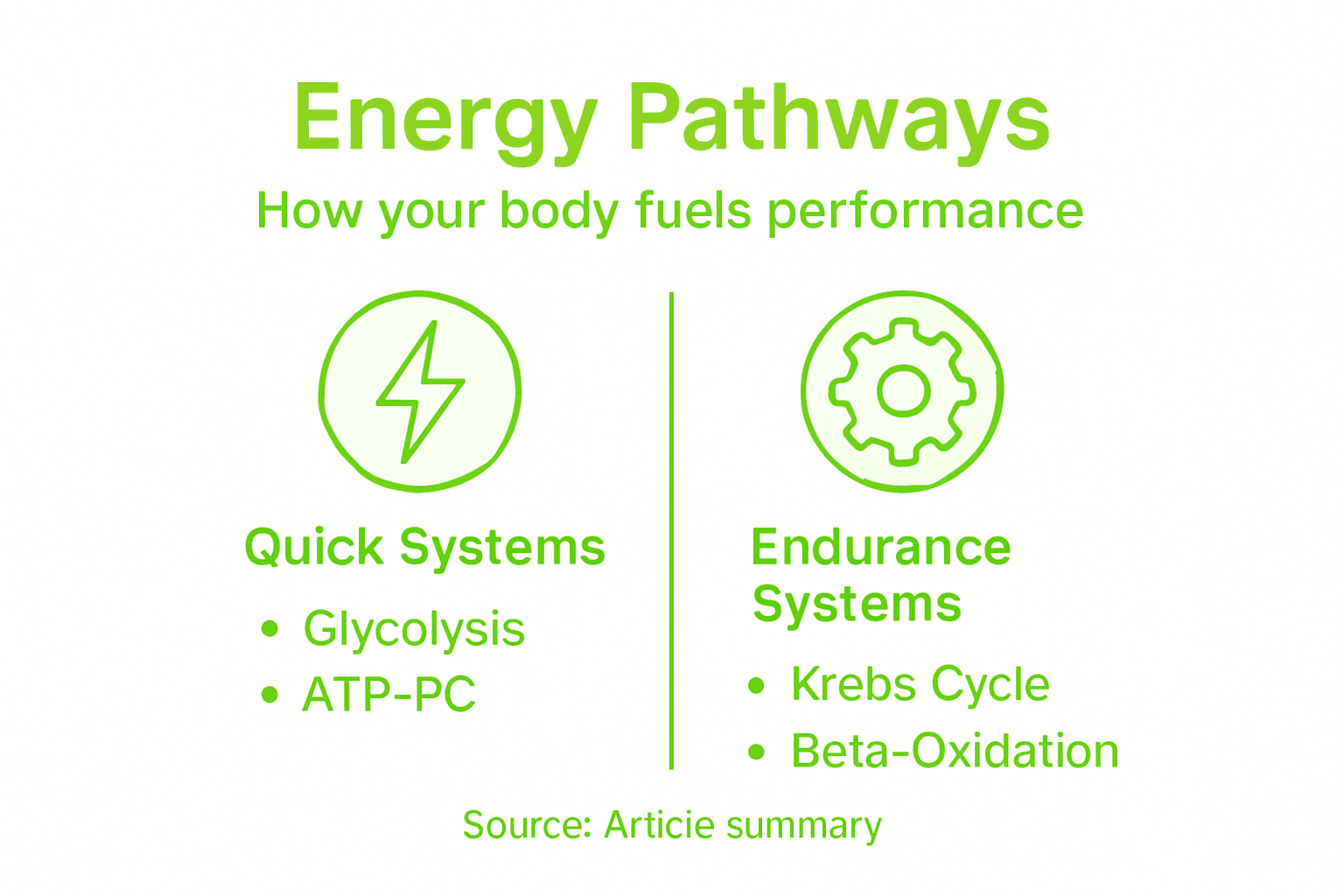
Your body doesn’t rely on a single energy system. Instead, you’ve got multiple interconnected pathways working simultaneously, each specialising in different fuel sources and operating under different conditions. Think of them like different routes to the same destination. You might take the motorway when you need speed, a country road when fuel efficiency matters, or public transport when conditions demand it. Your metabolic pathways work the same way. Multiple interconnected metabolic pathways including glycolysis, the Krebs cycle, beta-oxidation of fats, and oxidative phosphorylation handle the conversion of carbohydrates, fats, and proteins into usable energy. Each pathway operates in different cellular locations and activates based on what fuel your body has available and what your muscles need at that moment.
Let’s break down the main pathways you should understand as an athlete:
Glycolysis is your fast-acting system. This pathway breaks down glucose (carbohydrates) into pyruvate, releasing small amounts of ATP quickly without requiring oxygen. This is what powers your muscles during high-intensity efforts like heavy compound lifts or sprint intervals. It’s efficient for short bursts but produces lactate as a byproduct, which builds up when you’re working hard.
The Krebs Cycle (also called the citric acid cycle) is your precision system. It processes the pyruvate from glycolysis plus fatty acids and amino acids, extracting much more ATP per fuel molecule than glycolysis alone. This cycle requires oxygen and occurs inside the mitochondria. This is your aerobic engine, the pathway that sustains longer training sessions and steady state cardio.
Beta-oxidation is your fat-burning pathway. When your body breaks down fatty acids for energy, this is the process that handles it. It’s slower than glycolysis but yields tremendous ATP per molecule, making it incredibly efficient for prolonged, lower-intensity activity. This is why steady-state cardio or active recovery relies heavily on fat oxidation.
Oxidative phosphorylation is where the real energy payoff happens. This process uses the electrons extracted from carbohydrates and fats to generate the bulk of your ATP through a series of chemical reactions in the mitochondria. Without this final step, all the other pathways produce far less usable energy.
Here’s the practical reality: which pathways dominate depends on several factors. Oxygen availability matters enormously. When you’re sprinting and oxygen is limited, your body favours glycolysis. When you’re recovering or doing steady cardio with plenty of oxygen available, the aerobic pathways dominate. Your tissue type also influences which pathway is active. Muscle tissue specialises in using glucose and fats depending on intensity. The liver plays a central role in metabolism, capable of both storing and mobilising fuels as needed for your entire body.
Different tissues also specialise in particular fuels based on their energy demands. Your brain strongly prefers glucose. Your heart loves fatty acids. Your muscles can use both effectively depending on the training stimulus. This is why periodising your training and nutrition matters. During a heavy strength phase, your body prioritises glucose and glycolytic capacity. During a conditioning phase, your aerobic pathways and fat oxidation improve. You’re literally training different energy systems.
The key point here is that metabolic control points ensure energy production meets your cell’s needs and prevent wasteful cycles. Your body doesn’t randomly activate pathways. Enzymes and hormones regulate these pathways with precision. When ATP levels are high, anabolic pathways activate. When energy is low, catabolic pathways kick in. Understanding this means understanding that you can’t simply “activate” one pathway through supplementation. You activate pathways through training stimulus, fuel availability, and recovery.
Here’s a summary of the main energy pathways and their characteristics:
| Pathway | Primary Fuel Source | Speed & Intensity | Key Byproducts |
|---|---|---|---|
| Glycolysis | Carbohydrates (glucose) | Rapid, high intensity | Lactate |
| Krebs Cycle (Citric Acid) | Carbs, fats, proteins | Moderate, steady intensity | CO₂, water |
| Beta-oxidation | Fatty acids | Slow, low to moderate effort | CO₂, water |
| Oxidative phosphorylation | Electrons from fuels | Sustained, all intensities | Water, ATP |
Pro tip: Track your training intensity and nutrition timing alongside your recovery metrics. High-intensity sessions deplete glycolytic capacity and require adequate carbohydrates post-workout, whilst steady-state work improves aerobic pathways and fat oxidation, so fuel these differently.
Macronutrients and ATP production explained
Here’s the brutal truth: without ATP, you’re not lifting anything. ATP (adenosine triphosphate) is the universal energy currency of your cells. Every contraction, every repair, every adaptation happens because ATP is there to fund it. The entire reason you eat food is to create ATP. Your three macronutrients—carbohydrates, proteins, and fats—exist for one purpose at the cellular level: to be broken down and converted into ATP through specific biochemical pathways. Macronutrients are broken down through biochemical pathways to generate ATP, the primary molecule that stores and transfers energy within cells. When ATP is hydrolysed, energy is released and used for everything your muscles do. Different macronutrients take different routes to create ATP, and understanding those routes explains why your nutrition timing and composition actually matter for performance.
Let’s start with carbohydrates because they’re your fastest route to ATP. When you consume carbohydrates, they’re broken down into glucose and enter glycolysis, where each glucose molecule yields 2 ATP molecules quickly. That pyruvate then enters the citric acid cycle in your mitochondria and generates significantly more ATP. The total yield from one glucose molecule is approximately 30 to 32 ATP under optimal conditions. This is why carbohydrates are your go-to fuel for intense training. They’re fast. They’re efficient in the short term. Your muscles can access this ATP within seconds of intense effort. This is also why you should be eating carbohydrates before and after training, not avoiding them like some outdated fitness myth suggests.

Fats are your endurance fuel. When you consume fats, they undergo beta-oxidation, a pathway that strips electrons from fatty acid chains and feeds them into the citric acid cycle and oxidative phosphorylation. A single fatty acid molecule yields far more ATP than glucose, sometimes 2 to 3 times as much depending on chain length. However, this process is slower. You can’t mobilise fat fast enough to power an intense squat session. That’s why steady-state cardio, recovery work, and lower-intensity conditioning tap into fat oxidation as their primary fuel. Energy for metabolic homeostasis and physical activity is derived from oxidising macronutrients, with fats supplying a sustained source via fatty acid oxidation. This distinction matters tremendously for how you structure your training and nutrition. High-intensity work demands carbohydrates. Lower-intensity work can run effectively on fat oxidation.
Proteins are your third option, but they’re not your first choice for energy. Your body breaks down amino acids through deamination, removing the nitrogen group so the carbon skeleton can enter energy pathways like the citric acid cycle. This works, especially during prolonged exercise or when carbohydrate availability is low, but it’s inefficient compared to fats or carbohydrates. More importantly, using amino acids for energy means they’re not available for muscle repair and adaptation. This is why adequate protein intake combined with sufficient carbohydrates and fats is crucial. You want to spare protein for its primary job: building and repairing muscle tissue.
Here’s what separates informed training from guessing. The ATP yield varies significantly based on macronutrient type and metabolic conditions. One gram of carbohydrate yields roughly 4 calories and approximately 30 to 32 ATP molecules per glucose unit. One gram of fat yields 9 calories but generates far more ATP per molecule. One gram of protein yields 4 calories but is metabolically expensive to process and should be reserved for protein synthesis. Understanding this explains why a perfectly balanced approach works better than extreme low-carb, high-fat, or high-protein diets. You need all three macronutrients working together. You need carbohydrates for intensity. You need fats for sustained energy and hormonal health. You need protein for recovery and adaptation.
The final piece is that vitamins and minerals act as co-factors in these metabolic reactions. B vitamins especially are critical for converting macronutrients into ATP. If your B vitamin status is poor, your ATP production suffers regardless of how much food you’re eating. This is why a comprehensive approach to supplementation includes not just macronutrient timing but ensuring your micronutrient status supports the metabolic machinery doing the actual work. You can have perfect macronutrient ratios, but if your magnesium, B6, and B12 are low, your ATP production is handicapped.
To clarify the nutritional impact on ATP production, here is a comparison of the macronutrients:
| Macronutrient | ATP Yield Per Molecule | Speed of ATP Production | Preferred Activity Type |
|---|---|---|---|
| Carbohydrate | 30-32 per glucose | Very rapid | Short, intense exercise |
| Fat | 100+ per fatty acid | Slow | Prolonged, low intensity |
| Protein | Variable, less efficient | Moderate to slow | Extreme deprivation only |
Pro tip: Time your carbohydrates around your high-intensity training sessions (before and immediately after) when your body prioritises rapid ATP production, whilst consuming fats and proteins consistently to support sustained energy and recovery.
Factors affecting energy metabolism rates
Your metabolic rate isn’t fixed. It’s not some immutable number you’re born with and stuck with for life. Yes, genetics play a role, but they’re far from the whole story. Energy metabolism rates are influenced primarily by genetics, age, sex, body size, and body composition, but the variables you can actually control matter tremendously for athletic performance. Lifestyle factors including diet quality, physical activity level, and muscle mass are the levers you can pull to shift your metabolic rate in your favour. This is where most people get it wrong. They obsess over genetics when they should be obsessing over the things they can change.
Let’s break down the controllable factors first because those are what actually affect your training and recovery. Muscle mass is the single biggest metabolic variable you can influence. When you build muscle through resistance training, you increase your resting metabolic rate because muscle tissue is metabolically active. It burns calories simply existing. Fat tissue doesn’t. Every kilogram of muscle you build raises your basal metabolic rate (BMR), the number of calories your body burns at rest before any activity happens. This is why resistance training isn’t just about looking bigger or lifting heavier. It’s a metabolic adaptation that pays dividends 24 hours a day. Someone with 10 kilograms more muscle mass than you will burn significantly more calories every single day, even whilst sleeping.
Diet quality affects metabolism through a process called the thermic effect of food (TEF), sometimes called diet-induced thermogenesis. Different foods require different amounts of energy to digest, absorb, and process. Protein has the highest thermic effect, requiring roughly 20 to 30 percent of its calories just to digest and absorb. Carbohydrates require about 5 to 10 percent. Fats require only 0 to 3 percent. This means eating adequate protein literally burns more calories in digestion than eating equivalent calories from carbohydrates or fats. Caffeine also slightly elevates metabolism, which is why pre-workout supplements containing caffeine can provide a modest metabolic boost. These are small effects individually, but they compound. Over months and years, the difference between a high-protein, training-focused nutrition approach and a random diet is substantial.
Physical activity level is the most variable factor in your daily energy expenditure. Two people with identical body composition, age, and sex can have completely different daily energy expenditure if one trains hard and the other doesn’t. Someone doing high-intensity training sessions burns significantly more energy during and after training due to excess post-exercise oxygen consumption (EPOC), sometimes called the afterburn effect. Your body continues burning elevated calories for hours after intense training as it repairs muscle tissue and restores normal physiological states. This is why your training programme matters more than any supplement or hack for metabolic rate.
Now, the factors you can’t change but absolutely should understand. Age naturally slows metabolism. This isn’t an excuse to accept decline, but it’s reality. Resting metabolic rate decreases approximately 2 to 8 percent per decade after age 30, primarily because people lose muscle mass with age. The solution isn’t accepting slower metabolism. It’s resistance training to maintain and build muscle despite ageing. Sex also influences metabolism because males typically have more muscle mass and less body fat than females, resulting in higher BMR on average. This is biological fact, not an excuse.
Here’s the critical piece most people miss: basal metabolic rate accounts for the majority of energy use and is influenced by muscle mass, with higher muscle mass leading to greater energy expenditure at rest. Understanding that BMR is your foundation is crucial. BMR is typically 60 to 75 percent of your total daily energy expenditure. Physical activity, TEF, and non-exercise activity thermogenesis make up the remaining 25 to 40 percent. This means that building and maintaining muscle through consistent resistance training is your highest-leverage intervention for improving metabolic rate. No supplement, diet hack, or cardio protocol will outmatch the metabolic impact of progressive strength training over months and years.
Pro tip: Prioritise progressive resistance training three to four times weekly to build and maintain muscle mass, which is the most effective way to increase your resting metabolic rate without relying on diet tricks or supplements.
Supporting energy metabolism through supplements
Let’s be honest. The supplement industry is packed with hyperbole. Metabolism boosters, fat burners, energy enhancers—the marketing makes them sound like they’ll transform your body overnight. The reality is far more nuanced. Yes, certain supplements can modestly support energy metabolism, but they’re not magic. They’re tools that work best when combined with proper training, solid nutrition, and adequate recovery. Most marketed metabolism boosting supplements lack strong scientific evidence for dramatic effects. However, some ingredients have genuine research backing them for modest metabolic support. Understanding the difference between hype and reality is what separates informed athletes from people wasting money on false promises.
Start with the fundamentals. Caffeine is the most researched and effective supplement for temporary metabolic elevation. It genuinely increases metabolic rate, though the effect is modest and temporary, typically lasting 3 to 5 hours. Caffeine increases alertness, improves focus during training, and can enhance performance during high-intensity work. A typical effective dose is 3 to 6 milligrams per kilogram of body weight, usually taken 30 to 60 minutes before training. For a 80-kilogram athlete, that’s roughly 240 to 480 milligrams. This is why quality pre-workout supplements containing caffeine can be legitimately useful. Protein supplementation also supports metabolism through diet-induced thermogenesis. Protein-rich foods and supplements increase metabolic rate more than fats or carbohydrates because your body expends significant energy digesting and processing protein. This isn’t a huge effect, but it’s real. Whey protein isolate, for instance, contains roughly 90 percent protein by weight and mixes well with water or your preferred liquid, making it convenient post-workout when whole food isn’t practical.
Creatine monohydrate is one of the most thoroughly researched supplements available, with consistent evidence supporting its effectiveness for strength and power output. Whilst creatine doesn’t directly boost metabolism, it improves ATP availability during high-intensity efforts, allowing you to train harder and longer. More intense training means greater stimulus for muscle growth and metabolic adaptation. Creatine also increases water retention within muscle cells, which supports protein synthesis. The standard protocol is 3 to 5 grams daily. You don’t need loading phases despite what some claim. Just consistent daily dosing works perfectly fine over weeks. Beta-alanine supplementation can support buffering of lactate during high-intensity training, potentially allowing slightly longer efforts before fatigue sets in. However, the evidence is less robust than creatine, and the effect is modest. Green tea extract contains catechins and caffeine, which together show minor synergistic effects on metabolism, but the magnitude is small compared to training stimulus.
Here’s what the research actually shows. Whilst genetics largely dictate metabolism, some dietary choices and supplements may modestly influence metabolic rate, but most approaches require consistent application over time. Additionally, supplements like branched-chain amino acids (BCAAs) and creatine are popular, but evidence for substantial performance enhancement is limited and inconsistent, which is why you need to prioritise the fundamentals. The hierarchy is clear. Proper training beats any supplement. Adequate nutrition beats any supplement. Quality sleep beats any supplement. Once those three foundational elements are solid, selective supplementation with proven ingredients like caffeine, creatine, and protein can provide marginal gains. But marginal gains compound over months and years.
The critical warning here is about supplement quality. The UK market has reasonably good regulation through the Food Standards Agency, but standards still vary. Products from reputable brands that conduct third-party testing, like those available through MyGymSupplements, ensure you’re getting what the label claims. Cheap supplements from unknown sources may contain undisclosed ingredients, incorrect dosages, or contaminants that could harm performance or health. This is non-negotiable. You should also understand that supplements are additions to a complete programme, not replacements for it. Supplements should not replace a balanced diet and proper training to support energy metabolism and performance. If your diet is poor and your training is inconsistent, no supplement will save you. If your fundamentals are solid, supplements can be the difference between good progress and great progress.
One final point about timing and effectiveness. Supplement timing matters for some products and not at all for others. Caffeine works best 30 to 60 minutes pre-training. Protein is useful post-workout but also any time you haven’t eaten adequate protein that day. Creatine doesn’t have a timing requirement because it builds up in your system over weeks. Some athletes become obsessive about timing, thinking they’ll lose gains without perfect meal timing or supplement windows. The research actually shows that total daily intake of protein, carbohydrates, and calories matters far more than splitting hairs over 30-minute windows. Yes, post-workout nutrition is valuable, but getting your total daily intake right is the priority.
Pro tip: Start with caffeine and creatine monohydrate as your core supplements, add a quality whey protein for convenience post-workout, ensure you’re from a tested brand like MyGymSupplements, and then reassess after 8 to 12 weeks to see if additions align with your actual results.
Mistakes to avoid with nutrition and recovery
You can train like a beast, but if your nutrition and recovery are poor, you won’t progress. That’s non-negotiable. Most athletes understand this conceptually, but their actual behaviours tell a different story. They make the same mistakes repeatedly, sabotaging their own progress without realising it. These mistakes aren’t subtle. They’re glaring errors that undermine energy metabolism, impair muscle adaptation, and leave you frustrated wondering why you’re not seeing results despite putting in the work.
The first major mistake is following overly restrictive diets. This is where most athletes go wrong. Someone starts a new training phase, decides they need to “clean up” their nutrition, and swings to an extreme. They cut calories drastically, eliminate entire food groups, avoid healthy fats thinking they’ll get fat, or restrict carbohydrates because some influencer claims they’re the enemy. Common nutrition mistakes that undermine health and recovery include following overly restrictive diets, excluding nutrient-dense foods like healthy fats and fruits, and failing to maintain balanced, sustainable eating habits. Overly restrictive plans can lead to nutrient deficiencies and rebound overeating. Your body needs energy to recover. Your muscles need protein to repair. Your hormones need dietary fat to function. Your nervous system needs carbohydrates to manage stress. When you restrict too aggressively, all of these systems suffer. You lose energy, strength output drops, recovery suffers, and you eventually crack and overeat everything in sight. This cycle is predictable and avoidable. Sustainable nutrition approaches with modest caloric deficits or surpluses work better than extreme restriction because you can actually maintain them.
The second mistake is neglecting whole foods in favour of processed alternatives. Yes, convenience matters. Yes, supplements fill gaps. But whole foods like vegetables, fruits, whole grains, and quality proteins contain micronutrients, fibre, and bioactive compounds that processed alternatives simply don’t offer. A whey protein shake is convenient post-workout, but it shouldn’t replace actual meals. Whole grain bread, oats, and brown rice provide sustained energy and fibre that white bread and sugary cereals don’t. Vegetables and fruits provide vitamins, minerals, and phytonutrients that multivitamins can’t fully replace. A balanced diet with appropriate caloric intake and macronutrient distribution aids recovery and overall health, with key mistakes including neglecting whole grains, fruits, vegetables, and adequate protein. The solution is straightforward. Make whole foods your foundation. Use supplements and processed foods for convenience and gaps, not as your primary nutrition source.
The third mistake is ignoring individual recovery needs. Recovery isn’t just about what you eat. It’s about sleep, stress management, active recovery, and how all these factors interact with your training stimulus. Two athletes can follow identical training programmes and nutrition plans, yet one recovers brilliantly whilst the other stagnates. Why? Because one is sleeping eight hours nightly, managing stress effectively, and taking deload weeks, whilst the other is chronically sleep-deprived, stressed, and training hard constantly. You can’t supplement your way around poor sleep. You can’t eat your way past chronic stress. Nutrition advice should be tailored to individual needs, especially those with medical conditions, and this applies to recovery broadly. Your individual situation matters. Your training age, stress levels, sleep quality, age, and training frequency all determine your recovery needs. A beginner lifter might recover fine on basic nutrition and moderate sleep. An elite athlete pushing limits needs meticulous nutrition timing, adequate sleep, and stress management.
The fourth mistake is not adjusting nutrition for training phases. Your caloric and macronutrient needs vary based on your training focus. During a heavy strength phase with intense sessions multiple times weekly, you need more calories and more carbohydrates than during a deload week of light activity. During a conditioning phase with high-volume cardio, your carbohydrate and total energy needs spike differently than during a hypertrophy phase. Many athletes eat the same way regardless of training demands. They wonder why they’re tired, weak, or not recovering. The solution is basic. Eat more on days with higher training demands. Eat less on easier days. Adjust carbohydrates and overall calories based on activity level. This doesn’t require perfect tracking, just awareness and flexibility.
The fifth mistake is neglecting post-workout nutrition timing. Whilst total daily nutrition matters most, post-workout is when your body is primed to absorb nutrients and begin recovery. Waiting three hours after training to eat your first meal is inefficient. What happens in the hours after training significantly impacts your recovery trajectory, which is why eating carbohydrates and protein within 30 to 90 minutes of finishing training supports faster glycogen replenishment and muscle protein synthesis. This doesn’t need to be fancy. A banana with peanut butter, a whey protein shake, or a sandwich with chicken works fine. The key is consuming something with carbohydrates and protein soon after training finishes.
Pro tip: Build your nutrition around whole foods, aim for moderate and sustainable calorie intake matched to your activity level, prioritise sleep equally with diet, and eat carbohydrates and protein within 90 minutes of finishing training sessions.
Unlock Your Metabolic Potential with Targeted Nutrition and Supplements
Understanding energy metabolism is crucial for athletes striving to enhance performance, recovery, and muscle growth. The article highlights the challenges of manipulating metabolic pathways through training and nutrition while clarifying common myths like fixed metabolic rates. If you aim to build muscle mass to raise your resting metabolic rate or want to fuel your body efficiently with the right macronutrients and supplements such as caffeine and creatine, you need dependable solutions that truly support your metabolic health.
Explore specially formulated products at MyGymSupplements.shop designed for your energy metabolism needs. Whether you are looking for high-quality protein supplements to aid muscle repair and growth, effective pre-workouts and creatine that help boost ATP production during intense sessions, or essential vitamins and minerals for metabolic support, we have you covered. Don’t let misconceptions about metabolism hold you back. Take control of your performance now with science-backed supplements and a nutrition plan tailored to your training goals. Visit MyGymSupplements.shop today and start transforming your metabolism for lasting results.
Frequently Asked Questions
What is energy metabolism and why is it important for athletes?
Energy metabolism refers to all the chemical reactions in the body that convert food into usable energy, primarily ATP. For athletes, understanding energy metabolism is crucial because it affects performance, recovery, and overall energy levels during training and competition.
How can athletes influence their metabolic rate?
Athletes can influence their metabolic rate by increasing muscle mass through resistance training, improving diet quality, and maintaining a consistent physical activity level. These factors help boost resting metabolic rate and enhance energy expenditure during exercise.
What role do macronutrients play in energy metabolism for performance?
Macronutrients—carbohydrates, fats, and proteins—serve different purposes in energy metabolism. Carbohydrates provide rapid energy for high-intensity exercise, fats are utilised for prolonged low-intensity activity, and proteins primarily support muscle repair rather than energy production. A balanced intake of all three is essential for optimal athletic performance.
Why is post-workout nutrition timing important for athletes?
Post-workout nutrition timing is vital because the body is most receptive to nutrient absorption right after training. Consuming carbohydrates and proteins within 30 to 90 minutes post-exercise helps replenish glycogen stores and supports muscle protein synthesis, facilitating faster recovery and better performance in subsequent sessions.
Recommended
- Understanding What Are Energy Gels and Their Benefits – MyGymSupplements
- What is Muscle Fatigue? Understanding Its Causes and Effects – MyGymSupplements
- What is Muscle Catabolism? Understanding Its Importance – MyGymSupplements
- Understanding the Importance of Hydration for Athletes – MyGymSupplements
- Biostarks | Metabolic Health
- Ernährung von Leistungssportlern: Verständlich Erklärt – Kühlkern UG (Haftungsbeschränkt)

0 comments