

Most British adults do not realise that collagen protein makes up more than a quarter of the total protein in mammals, directly impacting joint and skin health. As fitness routines intensify, understanding how collagen really works becomes crucial for those wanting optimal recovery and resilience. This quick guide tackles common myths, explains the science, and helps British fitness enthusiasts choose the right approach for lasting results.
Table of Contents
- Collagen Protein Defined And Common Myths
- Types Of Collagen And Their Distinct Roles
- How Collagen Supports Joints And Skin
- Effective Collagen Supplementation For Fitness Goals
- Comparing Collagen With Other Protein Sources
Key Takeaways
| Point | Details |
|---|---|
| Collagen’s Importance | Collagen protein is essential for maintaining the structure of connective tissues, comprising over a quarter of total protein in mammals. |
| Types of Collagen | Different collagen types serve unique functions; for example, Type I collagen is vital for skin and bone strength. |
| Supplementation Strategy | Collagen supplements should be combined with a balanced diet and vitamin C to enhance absorption and support tissue health. |
| Consideration for Athletes | Athletes should aim for 10-15 grams of collagen daily, consuming it before exercise for improved absorption and overall joint support. |
Collagen Protein Defined and Common Myths
Collagen protein is a fundamental structural protein found throughout the animal kingdom, representing a critical component of our body’s connective tissues. Quantitatively and functionally, it constitutes over a quarter of the total protein in mammals, making it an essential biomolecule for maintaining structural integrity.
Derived primarily from animal connective tissues like skin, bones, and cartilage, collagen protein contains high concentrations of non-essential amino acids including glycine, proline, and hydroxyproline. These specific amino acids play a crucial role in supporting the body’s natural collagen production processes. Collagen is key to preserving the structural strength of connective tissues and is commonly promoted for its potential benefits in skin health, joint support, and injury recovery.
However, several common myths surrounding collagen protein persist in fitness and wellness circles. Many individuals mistakenly believe that collagen supplements can completely replace protein powders or that consuming collagen guarantees instant skin rejuvenation. In reality, collagen supplementation works best as a complementary nutritional strategy, supporting overall tissue health and potentially enhancing recovery when combined with a balanced diet and consistent exercise routine.
Pro Tip for Collagen Supplementation: Start with a low dosage and gradually increase while monitoring your body’s response, as individual absorption and effectiveness can vary significantly between different people’s metabolic profiles.
Types of Collagen and Their Distinct Roles
Collagen is not a singular protein but a complex family of proteins with multiple variants, each serving unique physiological functions. Major types of collagen include fibril-forming collagens, basement membrane-associated collagens, and transmembrane collagens, with type I collagen being the most abundant, representing critical structural components across different body systems.
Collagen can be subdivided into distinct categories based on their structural characteristics and functional roles. The primary categories include:
-
Fibril-forming Collagens (Types I, II, III, V, XI): These form long, thin fibrous networks in connective tissues like skin, tendons, and bone. Type I collagen predominates, creating robust structural frameworks.
-
Network-forming Collagens (Type IV): These create intricate meshwork structures crucial for basement membrane integrity and cellular support.
-
Fibril-Associated Collagens with Interrupted Triple Helices (FACIT) (Types IX, XII, XIV): These provide flexibility and enhanced structural support in complex tissues like cartilage.
Pro Tip for Collagen Type Selection: When choosing a collagen supplement, consider your specific fitness or wellness goals, as different collagen types target varying physiological needs and tissue support mechanisms.
Here is a comparison of major collagen types and their primary benefits:
| Collagen Type | Main Location | Unique Function |
|---|---|---|
| Type I | Skin, bones, tendons | Provides tensile strength, structural framework |
| Type II | Cartilage | Cushions joints, supports flexibility |
| Type III | Muscles, blood vessels | Maintains organ structure and tissue elasticity |
| Type IV | Basement membranes | Supports filtration and cellular adhesion |
How Collagen Supports Joints and Skin
Collagen protein plays a critical role in maintaining the structural integrity and functional health of both joint tissues and skin. Collagen supplementation has been found to be particularly beneficial for promoting skin elasticity and hydration, reducing wrinkles, and supporting joint function by improving cartilage and tendon health.
In the context of joint health, collagen serves as a fundamental building block for cartilage, tendons, and ligaments. As we age, natural collagen production declines, which can lead to decreased joint flexibility, increased discomfort, and slower recovery from physical activities. By providing essential amino acids and supporting connective tissue regeneration, collagen supplements can help athletes and fitness enthusiasts maintain optimal joint performance and reduce the risk of injury.
For skin health, collagen is equally transformative. The protein provides critical structural support, helping maintain skin’s firmness, elasticity, and moisture retention. Regular collagen supplementation can potentially counteract age-related skin changes, supporting a more youthful appearance by minimising fine lines and improving overall skin texture.

Pro Tip for Collagen Supplementation: Combine your collagen intake with vitamin C-rich foods to enhance protein absorption and maximise your body’s natural collagen synthesis process.
Effective Collagen Supplementation for Fitness Goals
Collagen supplementation represents a strategic approach to supporting athletic performance and recovery, though its role differs significantly from traditional protein supplements. Unlike muscle-building protein powders, collagen is primarily used to support the body’s structural framework, focusing on skin elasticity, joint mobility, and injury recovery.
Collagen’s diverse presence across multiple tissue types, including tendons, ligaments, bone, skin, and blood vessel walls, makes it a crucial component for athletes seeking comprehensive physiological support. Its primary function in the extracellular matrix involves providing strength, facilitating cell migration, and supporting tissue repair processes that are essential for athletes experiencing high-intensity training stress.
When integrating collagen into a fitness regimen, timing and dosage become critical considerations. Consuming collagen approximately 30-60 minutes before exercise can potentially enhance its absorption and utilisation, particularly when combined with vitamin C to support protein synthesis. Athletes should aim for 10-15 grams of collagen daily, understanding that its benefits accumulate gradually rather than providing immediate performance enhancements.
Pro Tip for Supplement Timing: Consume your collagen supplement with a source of vitamin C to maximise protein absorption and support your body’s natural collagen synthesis mechanism.
Comparing Collagen With Other Protein Sources
Protein supplements vary significantly in their composition and physiological roles, with collagen presenting a unique profile distinct from traditional muscle-building proteins. Unlike standard protein powders, collagen does not significantly contribute to muscle-building but instead supports the body’s structural framework, focusing on tissue integrity and repair mechanisms.
Collagen’s versatility stems from its presence across diverse bodily tissues, including tendons, ligaments, bone, skin, and blood vessel walls. While whey, casein, and plant-based proteins primarily aim to stimulate muscle protein synthesis, collagen specialises in extracellular matrix support, providing strength and facilitating cell migration.
Key differences between collagen and other protein sources include amino acid profiles, absorption rates, and targeted physiological functions. Whey protein contains higher levels of branched-chain amino acids ideal for muscle growth, whereas collagen is rich in glycine, proline, and hydroxyproline, which are crucial for connective tissue health. Athletes seeking comprehensive supplementation might consider incorporating both to address different physiological needs.
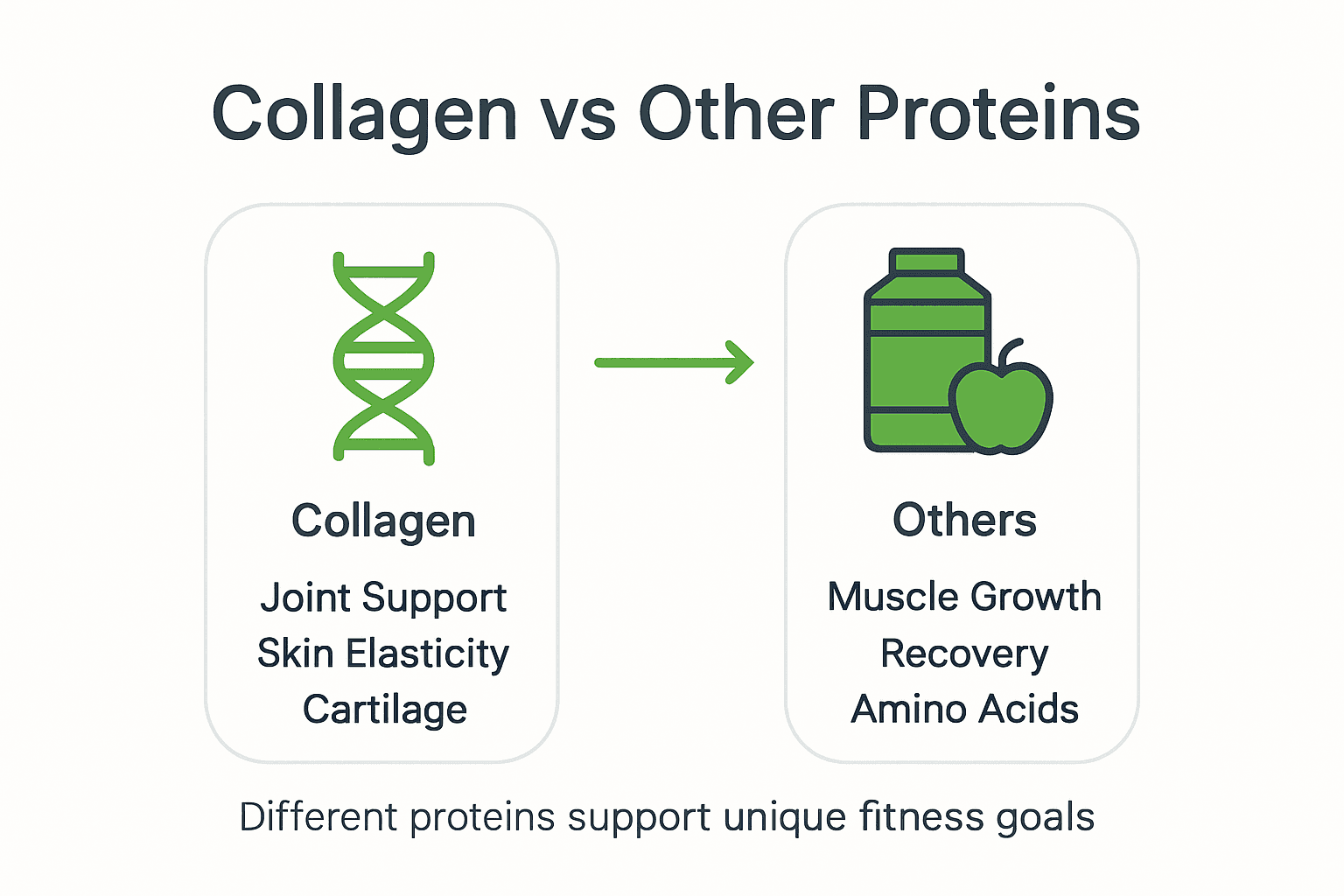
This table summarises key differences between collagen and common protein supplements:
| Protein Source | Primary Purpose | Key Amino Acids | Typical Application |
|---|---|---|---|
| Collagen | Tissue repair, skin & joints | Glycine, proline, hydroxyproline | Joint health, skin elasticity |
| Whey | Muscle growth & recovery | BCAAs, leucine, isoleucine | Muscle-building, post-exercise |
| Casein | Sustained protein release | Glutamine, BCAAs | Overnight muscle support |
| Plant-based | General dietary protein | Varies by plant type | Vegan nutrition, general health |
Pro Tip for Protein Selection: Balance your protein intake by combining collagen with traditional protein sources to support both structural tissue health and muscle development.
Unlock Your Best Performance with Targeted Collagen Support
Understanding the true role of collagen protein in fitness reveals a crucial gap many athletes and health-conscious individuals face. Whether your goal is improving joint flexibility, enhancing skin elasticity, or speeding up recovery after intense workouts, addressing collagen deficiencies can be a game changer. This article highlights how collagen works alongside other proteins to rebuild and strengthen connective tissues, a need often overlooked in traditional protein supplementation.
Ready to elevate your fitness journey with collagen designed for structural health and performance? Explore our premium selection of collagen supplements alongside whey, casein, and plant-based proteins to build a comprehensive nutritional foundation.
Take control of your recovery and skin health today by visiting MyGymSupplements.shop where you can shop by goal and category easily. Discover how the right collagen product can support your connective tissue and joint comfort alongside muscle-building options. Act now to experience the difference of tailored collagen supplementation and optimise your training results.
Frequently Asked Questions
What is collagen protein?
Collagen protein is a vital structural protein that makes up a significant portion of our body’s connective tissues, providing strength and support to skin, bones, tendons, and ligaments.
What are the main benefits of collagen supplementation for fitness?
Collagen supplementation can support joint health, improve skin elasticity, and aid in injury recovery by providing essential amino acids that help repair and regenerate connective tissues.
How should I incorporate collagen into my fitness routine?
To maximise the benefits of collagen, consume it about 30-60 minutes before exercising, ideally paired with a source of vitamin C to enhance absorption and support protein synthesis.
How does collagen compare to other protein supplements?
Unlike traditional protein powders that focus on muscle building, collagen primarily supports tissue integrity and repair. It is rich in amino acids like glycine and proline, which are essential for connective tissue health.
Recommended
- Unlock the Power of Marine Collagen: Elevate Your Health and Beauty Regimen – MyGymSupplements
- Enhance Skin and Joint Health: MyProtein Collagen Caps – MyGymSupplements
- Discover Optimum Nutrition Clear + Collagen Benefits Now – MyGymSupplements
- 7 Essential Types of Protein Supplements Explained – MyGymSupplements

0 comments